
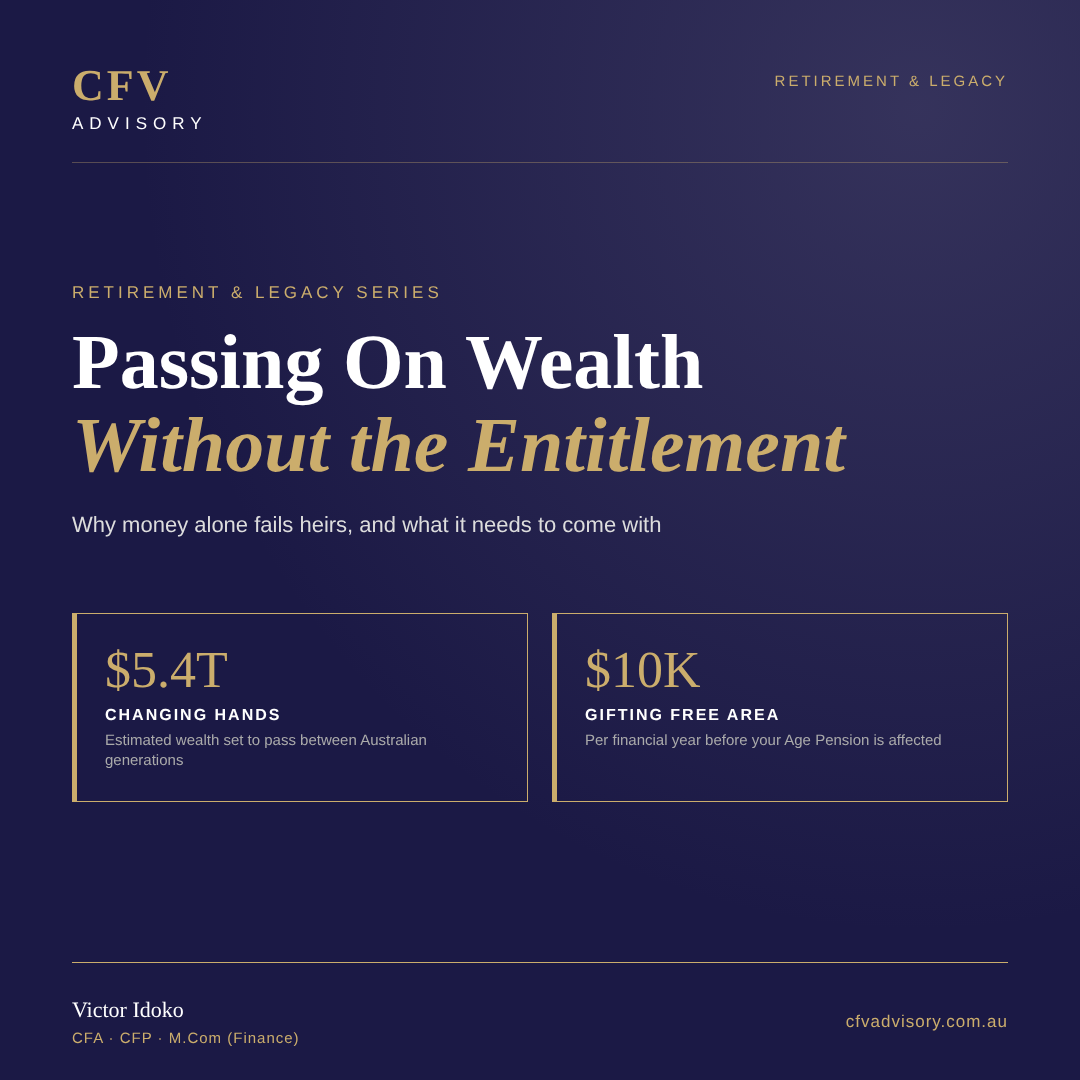
Passing on wealth is the easy part: a will, a nomination, a signature. Passing on the judgement to handle it is much harder. And with an estimated $5.4 trillion set to move between Australian generations, that second job has never mattered more.
Key takeaways
You have spent forty years building something. The home is close to paid off, super is solid and the kids are grown. Yet one quiet question sits underneath it all. Will what we leave actually help them, or could it hurt them?
That worry is far from unusual. In fact, it comes up in almost every retirement conversation we have about family. What’s more, it is becoming more urgent. JBWere’s 2024 Bequest Report puts the coming wealth transfer at about $5.4 trillion. That is well above the Productivity Commission’s earlier $3.5 trillion estimate. At the same time, Finder’s 2026 Home Loan Report found three in ten homeowners had family help to buy.
So this article looks at passing on wealth through a different lens. Instead of asking how much to leave, it asks what needs to come with it. Put simply, wealth plus values beats wealth alone. Every time.
“Money without context is just a windfall. Money with values, guidance and structure becomes a legacy.”
— Victor Idoko, CFA, CFP
At a glance
Entitlement vs Empowerment at a Glance
Subtle difference. Huge outcome.
Why Passing On Wealth Alone Fails Heirs
Money alone usually fails heirs because it arrives without context, guidance or practice. There is a figure quoted widely in wealth circles. Roughly 70% of family wealth is said to be gone by the second generation, and 90% by the third. The exact numbers are debated. However, the pattern behind them is familiar to anyone who has worked with families for long enough.
Crucially, the money rarely disappears because of markets or tax. Instead, it fades because heirs were never prepared and expectations were never spoken aloud. For example, a son receives a large sum with no idea how it was built. Meanwhile, two siblings each assume a different version of ‘fair’. As a result, the inheritance becomes a source of strain rather than security.
In other words, context and guidance matter as much as the inheritance itself. Passing on wealth without them is a bit like handing over car keys without driving lessons.
The finding
Most family wealth doesn’t vanish through bad investments. It fades through unprepared heirs and unspoken expectations.
Entitlement vs Empowerment: Helping Adult Children the Right Way
The right kind of help builds an adult child’s capability instead of replacing it. Entitlement in adult children rarely looks like a spoiled toddler. It is quieter than that. For instance, it can look like treating a future inheritance as a retirement plan. It can also look like repeated help to clear bad debt. Think credit cards, car loans or buy now pay later.
Importantly, none of this makes your children bad people. It is structural, not personal. If help has always arrived without conditions, why would they expect anything different? That said, the same love can be expressed in a way that builds capability instead of replacing it.
Empowerment, by contrast, looks like adult children who understand your plan in broad terms. They carry their own responsibilities. Furthermore, any help you give is aimed at good debt, like a home loan, and comes with clear terms.
The finding
Ask one question before every gift: does this build their capability, or quietly replace it?
How Much Can You Give Without Risking Your Retirement?
In short, give only your genuine surplus. If you receive or expect the Age Pension, also stay within Centrelink’s gifting limits. One of the biggest fears we hear is being a burden on the kids later. Ironically, generous early gifting is one of the fastest ways to make that fear come true. In late October, The New Daily warned about exactly this. Parents dipping into savings for the Bank of Mum and Dad may be risking their own retirement.
The Age Pension rules add another layer. Under Services Australia’s gifting rules, you can give away $10,000 a financial year in 2026–27. There is also a cap of $30,000 over five rolling financial years. Notably, those limits apply to a single person or a couple combined.
Anything above the free area is still counted as your asset for five years. In addition, it is deemed to earn income under the income test. Deeming simply means Centrelink assumes your financial assets earn a set rate, whatever they actually earn. Therefore, a large gift can reduce your pension for years after the money has gone. Aged care costs can be affected too.
This is why a solid retirement plan comes before any gifting decision. First, work out your own ‘enough’ number, year by year, with aged care modelled early. Then, and only then, the genuine surplus becomes money you can give with confidence.
The finding
The kindest gift to your children may be a retirement that never needs rescuing.
Gift or Loan? Wills, Super Nominations and Family Agreements
Both gifts and loans work, but each has a trade-off. Generosity without structure creates risk for everyone involved. For example, Money.com.au found 64% of first-home buyers with family help had no formal agreement in place. That gap can hurt if a child’s relationship breaks down or a sibling later feels short-changed.
Fortunately, a few simple structures solve most of these problems. Consider these options before passing on wealth during your lifetime.
Illustrative example
Worked example: a $50,000 gift vs a $50,000 loan
Consider an illustrative couple aged 68 and 66. They own their home and receive a part Age Pension under the assets test. They want to give their daughter $50,000 towards a home deposit.
As a gift: only $10,000 falls within the free area. The other $40,000 still counts as their asset for five years. Under the assets test, the pension falls by $3 a fortnight for every $1,000 of assets. That means roughly $120 a fortnight less than if the whole gift were exempt. Over five years, that is around $15,600.
As a documented loan: the full $50,000 keeps counting as their asset, and is deemed, until it is repaid. Their pension doesn’t rise at all. On the other hand, the money stays legally theirs if their daughter’s relationship breaks down.
Neither option is wrong. The right choice depends on their cash flow, their daughter’s situation and their estate plan. That is the reality of passing on wealth while you are alive.
Tax matters too. Australia has no inheritance tax. However, super paid to financially independent adult children is usually taxed. The rate is 15% plus the Medicare levy on the taxable component. That is the part built from employer contributions, salary sacrifice and earnings. In addition, capital gains tax usually applies when an heir later sells an inherited asset.
If asset protection is front of mind, Victor unpacks guarantor risks and family structures in this episode with Ury Zhang.
The finding
Write it down. A documented arrangement protects your child, your relationships and your retirement.
Passing On Values to Children and Grandchildren
The most valuable inheritance is often given while you are alive. Specifically, it is the story of how the wealth was built. Tell your children about the sacrifices, the mistakes and the decisions that paid off. As a result, the money stops being an abstract number and becomes something earned.
Next, invite your adult children into the conversation. You don’t need to share every figure. However, they should understand your plan, your wishes and where key documents live. A calm, structured family meeting can achieve this without old tensions taking over. It also makes passing on wealth later far smoother.
Grandparents also have a superpower here: time. For instance, you might match a grandchild’s savings dollar for dollar. Equally, you could pay for a real job around the house rather than simply handing over cash. Reading Bunnies & Monies, the children’s series Victor co-authored, is another gentle way to start.
For longer-term help, some grandparents prefer investment bonds for the next generation over direct cash gifts. The key, however, is pairing any money with a responsibility the child understands. That is what makes passing on wealth to grandchildren work.
The finding
Values are taught by example and repetition. Start with one small responsibility, not a lecture.
Quick check: do your children or grandchildren have regular money responsibilities?
Your Legacy Readiness Check
Before passing on wealth in any form, run through this list together. Each ‘no’ is simply a conversation still to have.
Who This Guide May Not Suit
This guide is general and written for couples nearing or in retirement who are thinking about passing on wealth. It may not suit you in these situations.
The Numbers Behind the Handover
Inheritance and Gifting: Frequently Asked Questions
Is there an inheritance tax in Australia?
No. Australia has no inheritance or estate tax. However, tax can still apply. For example, super paid to financially independent adult children is usually taxed. The rate is 15% plus the Medicare levy on the taxable component. In addition, capital gains tax usually applies when an heir later sells an inherited asset.
How much money can I gift my children without affecting my Age Pension?
In 2026–27, you can gift $10,000 per financial year, up to $30,000 over five rolling financial years. These limits are the same for a single person or a couple combined. Anything above them is still counted as your asset, and deemed to earn income, for five years.
Should I give my children their inheritance early?
Only once your own retirement is secure. First, model your income needs year by year, including aged care. Then any genuine surplus can be given while you are alive. That way, you see it help and can pass on guidance alongside it.
Is it better to gift or lend money to an adult child?
It depends on what matters most to you. A documented loan protects the money, for instance if your child’s relationship breaks down. However, Centrelink counts a loan as your asset until it is repaid. By contrast, a gift above the free area only counts for five years.
How do I leave an inheritance without making my children entitled?
Pair the money with values and responsibility. Explain how the wealth was built and involve adult children in your plan. In addition, structures like testamentary trusts can protect beneficiaries who may not be ready for a lump sum.
Does my will cover my superannuation?
Not automatically. Super is paid by your fund trustee, not your will. Therefore, a valid binding death benefit nomination is usually needed to make sure super goes where you intend.
What to Do Next
You have done the hard part. The wealth is built. Now the goal is to protect your own retirement first. Then you can hand on both the money and the wisdom behind it.
Ultimately, these decisions are hard to undo once made. That is exactly why trusted advice before retirement makes such a difference. If you want to go deeper first, Victor covers estate and Age Pension questions on this Elevate Your Wealth episode. You may also find our guide to building and passing on generational wealth helpful.
Finally, if you know a couple quietly wrestling with how to help their kids, pass this on. It might start the conversation they have been putting off.
🎧 Prefer to listen? Catch this episode on the Two Incomes, One Plan podcast.
About the author
Victor Idoko
CFA · CFP · M.Com (Finance) · Founder, CFV Advisory
Victor helps Australian couples approaching retirement know how much is enough, and hand on what they have built with care. He is the author of 7 Basic Wealth Strategies and 5X Your Wealth, and co-author of the children’s series Bunnies & Monies. He also hosts the Elevate Your Wealth podcast. To talk through your own situation, visit cfvadvisory.com.au.
You’ve done the hard part. Let’s make sure you get to enjoy it.
One conversation can map out what you need for retirement, what you can safely give, and how to hand it on well.
Plain English. Calm, careful planning. Don’t Wing It. Plan It.
Last updated 3 November 2026. General advice disclaimer: the information in this article is general in nature and does not take into account your personal objectives, financial situation or needs. It is not personal financial, tax, legal or Centrelink advice. Before acting on any information, consider whether it is appropriate for your circumstances and seek advice from a licensed financial adviser and, where relevant, a solicitor. Centrelink gifting limits and rules reflect published information at the time of writing and may change. Examples are illustrative. CFV Services Pty Ltd is an Authorised Representative of Spark Advisors Australia.