
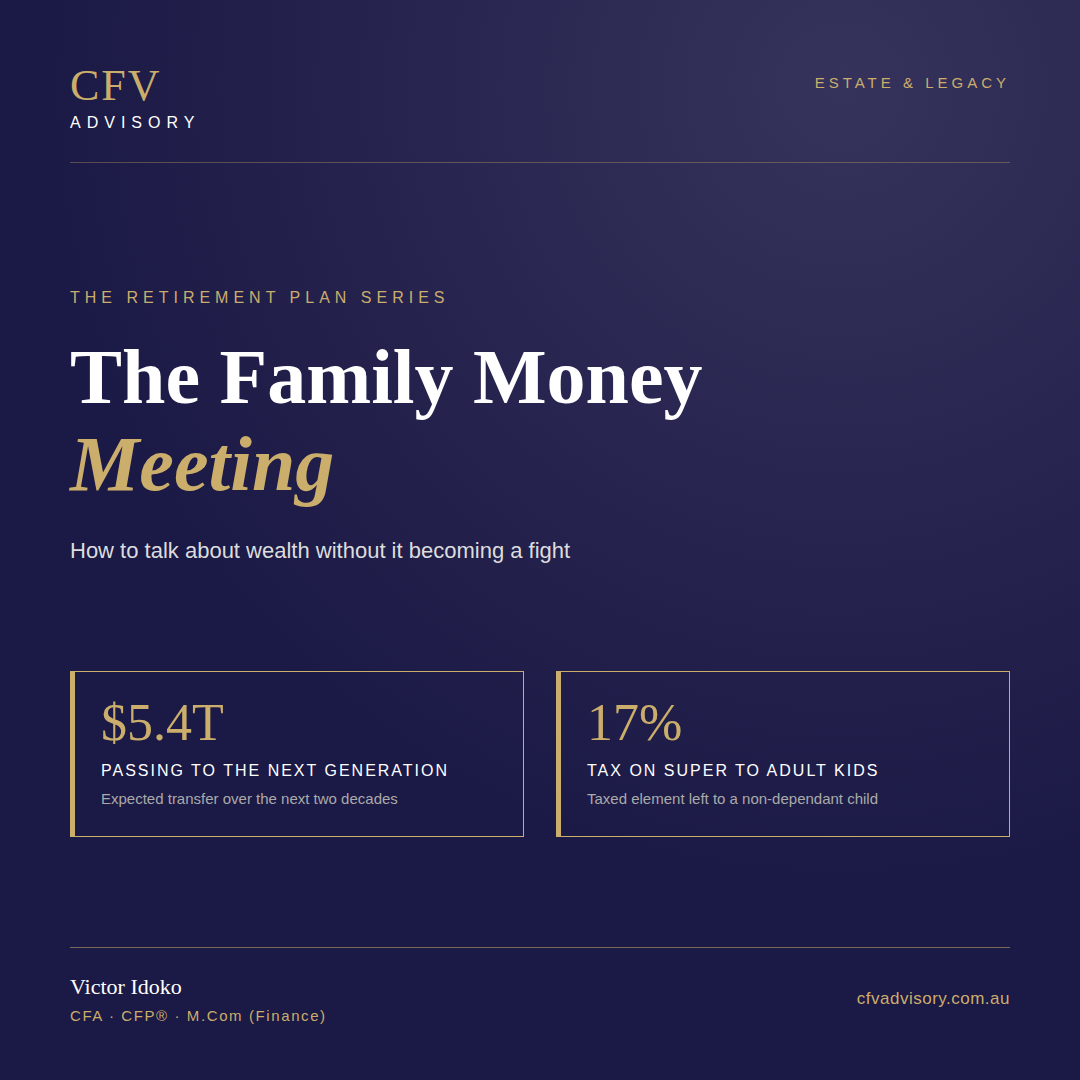
A family money meeting is the cheapest piece of estate planning you will ever do. Yet most Australian families never hold one. Meanwhile, around $5.4 trillion is expected to pass to the next generation over the next two decades.
You have done the hard part. The mortgage is nearly gone, the super is solid, and the plan finally works on paper. However, one piece is usually missing: the family money meeting. In other words, the conversation with the people who will one day live with every decision you have made.
Most couples avoid it, and for understandable reasons. First, it feels morbid. Second, it can feel like bragging. Above all, it feels like the fastest way to start an argument that never quite ends.
That said, silence is not neutral. Silence simply moves the conversation to a worse moment. Consequently, families end up making decisions in a hospital corridor, at a funeral, or through a solicitor’s office.
Here is the reassuring part. The families who handle this well are rarely the wealthiest ones. Instead, they are the families who prepared, followed an agenda, and kept the first conversation short.
“Families rarely fall out over the size of an estate. They fall out over the surprise.”
The 60-Minute Family Money Meeting
Why silence creates financial fragility
Financial fragility has very little to do with how much you have. Rather, it describes how much depends on one person knowing everything. In most households, that person is you.
So consider a simple test. If you were unavailable for six weeks, who would know which fund holds your super? Who could find the original will? Who would know whether that income protection policy was cancelled back in 2019?
As a result, families lose money in small and avoidable ways. For example, accounts sit frozen, premiums lapse, and property gets sold in a hurry. Furthermore, an executor working blind pays professionals to rebuild information the family already owned.
This gap is remarkably common. Australian estate lawyers report a striking figure. Roughly 44 per cent of people have no will, or cannot say whether they have one. In short, the paperwork problem is really an information problem.
What actually starts the fight
In practice, disputes rarely begin with the dollar amount. Instead, they begin with a surprise. Money is simply the scoreboard the surprise gets measured on.
Four surprises cause most of the damage. First, unequal shares that were never explained. Second, a blended family arrangement nobody discussed openly. Third, a family home informally promised to one child. Finally, an executor appointment that lands like a judgement on everyone else.
Equal is not always fair. Similarly, fair is not always equal. However, unexplained is almost always resented.
This is precisely why the family money meeting matters more than the documents. Documents allocate. Conversations explain. Ultimately, the explanation is the part that survives you.
Before your family money meeting, preparation does most of the work
Preparation removes most of the tension before anyone sits down. To begin with, build a one-page map of your affairs. It does not need balances, and it should fit on a single sheet.
Next, decide what you will and will not share. Notably, you are under no obligation to disclose figures. Many families share structure and intent only, which is usually enough to prevent a fight.
Then agree everything with your partner first. Above all, adult children should never watch the two of you disagree about money for the first time.
Finally, choose the setting deliberately. Avoid Christmas lunch, birthdays and hospital rooms. Instead, pick a neutral weekday, skip the alcohol, allow sixty minutes, and send the agenda a week ahead.
The five-item agenda that keeps everyone calm
Your family money meeting should follow a fixed order. Structure is what stops one strong personality from setting the direction. Additionally, it gives quieter family members a predictable place to speak.
Item one sets the purpose in a single sentence. For instance: we want you to hear the plan from us, so nobody has to guess later. Item two covers what exists and where it lives, at whatever level of detail you have chosen.
Item three assigns the roles. Who is the executor, and why? Who holds the enduring power of attorney if you cannot make decisions? Crucially, say the reasoning out loud, because reasoning prevents resentment.
Item four is the one most families skip: health, care and the home. Would you stay at home as long as possible? Would you accept residential aged care? Does anyone in the family expect to become a carer? Item five then closes with questions and one small action each.
Scripts for the four hardest moments
Most people do not fear the topic. They fear a specific sentence they cannot answer. Therefore, prepare four of them in advance and the rest becomes manageable.
That third script deserves a note. Early help can be genuinely sensible, and sometimes it is far more useful than an inheritance decades later. For example, clearing bad debt can change a young family’s trajectory immediately. Credit cards and buy now pay later are the usual culprits.
Even so, treat the request as a planning question rather than a yes or no. A gift that reduces good debt on a home is different again from one that funds lifestyle spending. Moreover, gifting can affect Age Pension entitlements under the Centrelink gifting rules, so both the amount and the timing matter.
Above all, your own plan comes first. Helping the children only works if it does not quietly transfer your retirement risk onto them later.
Three things Australian families still get wrong
Your will may not control your super
Superannuation is generally not an estate asset. Therefore, your will does not automatically direct it. Instead, a valid binding death benefit nomination tells the trustee what to do. Without one, the trustee exercises its own discretion.
Tax matters here too. Super left directly to a financially independent adult child is not tax free. Specifically, the taxed element of the taxable component attracts 15 per cent tax. The 2 per cent Medicare levy applies as well. That is 17 per cent, or $68,000 on a $400,000 taxable component. The ATO sets out how death benefits are taxed in detail.
Consequently, this is worth checking before any family conversation. Many nominations lapse after three years, unless the fund offers a non-lapsing option.
The family home is not liquid
Two children, one house, and an instruction to share it equally sounds fair. In reality, it often forces a sale within twelve months. Alternatively, one child must find the cash to buy the other out at exactly the wrong moment.
For this reason, say out loud what you actually want to happen to the house. Then check whether the rest of the estate can fund that outcome.
Nobody can find anything
Executors routinely spend months reconstructing a financial life from bank statements and old emails. Meanwhile, the family waits, and professional fees accumulate.
In contrast, a single page listing accounts, advisers and document locations can save months. Put simply, it is the highest-value hour of admin in the whole plan.
What changed in 2026, and why families are talking now
The backdrop shifted again this month. New research from the Australian Institute of Family Studies landed this week. It shows inheritances and family gifts increasingly shape who gets ahead. Additionally, the welfare network Anglicare has renewed public calls for an inheritance tax. It puts the coming transfer at roughly $5.4 trillion.
At the same time, the super rules moved. Division 296 commenced on 1 July 2026 and applies additional tax to earnings tied to balances above $3 million. Furthermore, a minimum 30 per cent tax rate for discretionary trusts has been announced from 2028. That change is already reshaping how some family trust arrangements are used.
None of this changes the principle behind a family money meeting. However, it does change the urgency. Rules move regularly; therefore, a family that already talks about money adapts far faster than one that does not.
Crucially, you do not need to explain tax law to your children. You only need them to know that a plan exists, that it is reviewed, and who to call.
After the family money meeting, write one page and set a date
Finish by writing a one-page summary while it is fresh. Include what was discussed, what was decided, and what each person agreed to do. Then circulate it within a week.
Next, set an annual review. The anniversary rule works well: the same month each year, thirty minutes, and only what has changed. Consequently, the second conversation is always easier than the first.
Beyond that, revisit after any significant life event. A marriage, a separation, a birth, a diagnosis, a business sale or a property sale all justify an early check-in.
Finally, keep the tone consistent. This is a family briefing, not a negotiation, and certainly not a reading of the will.
What one hour actually protects
How to start your family money meeting this month
You do not need perfect documents to begin. You need a date, an agenda, and a first sentence. Everything else can be tidied up afterwards.
That said, some structures deserve professional review before the family sits down. For instance, blended families, an SMSF, a family trust or a business interest all carry irreversible decisions. In those cases, review the structure first, then hold the meeting with confidence. Two guides help here: building and passing on generational wealth, and the power of a solid retirement plan.
Victor also works through the retirement and estate questions families ask most. You can hear them in this episode on the retirement path.
Most importantly, remember what the hour is for. A family money meeting does not divide anything. Instead, it makes sure the people you love are never left guessing.
Victor Idoko is the Principal Financial Planner at CFV Advisory, an Australian practice working with pre-retirees, professional couples and business owners. He is the author of 7 Basic Wealth Strategies and his latest book, 5X Your Wealth. He also co-authored Bunnies & Monies, a children’s series about money habits at home.
As the host of the Elevate Your Wealth podcast, Victor interviews specialists across tax, property, insurance and estate planning. You can find more of his work at cfvadvisory.com.au.
Before you sit the family down, it helps to know the plan underneath is sound. We can review your super, nominations, insurance and estate structures, then help you decide what to share and how.
This article contains general information only. It does not take into account your objectives, financial situation or needs, and it is not personal financial, tax or legal advice. Superannuation, taxation and estate rules change, and figures quoted are current at the date of publication. You should consider whether the information is appropriate for you and seek advice from a licensed financial adviser, registered tax agent or solicitor before acting. Victor Idoko is a Principal Financial Planner at CFV Advisory (CFV Services Pty Ltd), an Authorised Representative of Spark Advisors Australia.