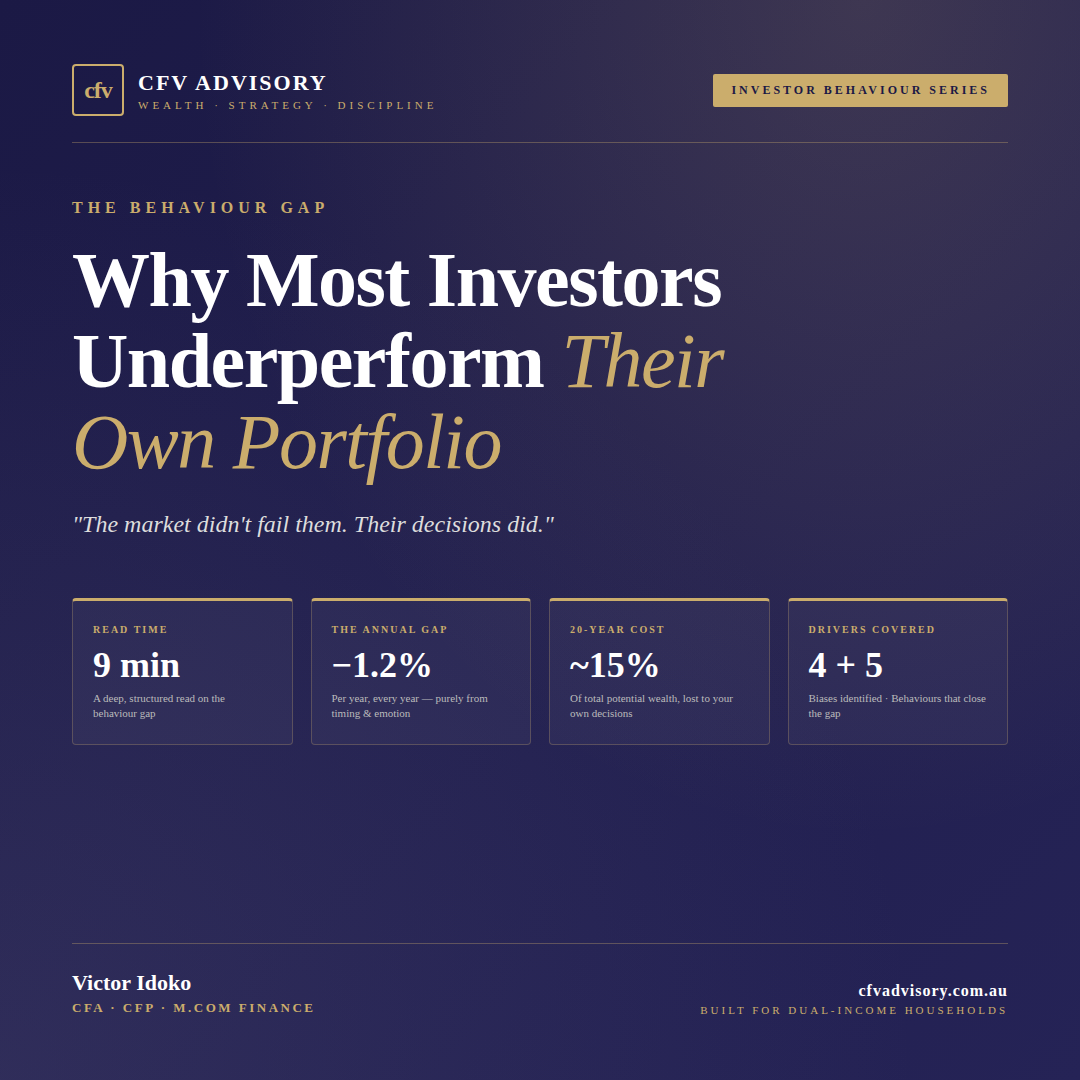
The investor behaviour gap costs the average Australian household around 1.2% a year — quietly, every year, on top of fees. Over a 20-year horizon, that is roughly 15% of your potential wealth simply lost to your own decisions.
The investor behaviour gap is the difference between the return your fund actually produced and the return you actually earned. They should be the same. They almost never are. Morningstar’s Mind the Gap study tracks this every year, and the latest decade — ending December 2024 — showed the average investor earned 7.0% per annum while the funds they owned returned 8.2%. Same fund. Same period. Different outcome.
For dual-income households earning $200,000–$400,000, that quiet gap matters more than almost any product decision you will make. As a result, the cost compounds in two directions at once: the lost return today, and the lost return on that lost return for every year afterwards. In short, you don’t underperform because you picked the wrong fund. You underperform because of what you do after you pick it.
This article walks through what the behaviour gap actually is, why it persists across markets and decades, the Australian super-fund evidence that makes it impossible to ignore, and the five behaviours that quietly close it.
“The market didn’t fail them. Their decisions did. The fund returned 8.2%. They earned 7.0%. The 1.2% they lost wasn’t paid to anyone — it simply didn’t compound.”
The gap, in numbers
What investors earned vs. what their funds returned
Fund Total Return
8.2%
Annualised return of the average fund, 10 years to Dec 2024
Investor Actual Return
7.0%
What the average dollar in those funds actually earned over the same period
The Behaviour Gap
−1.2%
Per year, every year — purely from timing, switching and inconsistency
Source: Morningstar Mind the Gap (2025), 10 years ended Dec 31, 2024.
01
What the data actually shows
Morningstar has been running the Mind the Gap study since 2005. The methodology is simple. They calculate the fund’s total return — the number you see on the fact sheet — and compare it to the dollar-weighted return earned by investors actually in that fund. Crucially, the dollar-weighted figure accounts for when people put money in and when they pulled it out.
For example, if everyone bought after a strong year and sold after a weak one, the fund could still return 8% a year while the average dollar earned far less. That, in essence, is what keeps happening. Furthermore, the gap appears in every calendar year of the study and across every major fund category.
Volatility makes the investor behaviour gap worse. The more dramatic the swings, the more investors trade — and the more they trade, the wider the gap becomes. In particular, sector and thematic funds (think AI funds, mining funds, single-country funds) show the largest gaps because they attract the most performance-chasing flows. Boring, well-diversified funds show the smallest gaps. Boring works.
Finding
Across two decades of US data, the more often investors traded, the less their average dollar made. Investors in low-turnover allocation funds beat investors in high-octane sector funds — even when the sector funds had higher headline returns.
02
Why the investor behaviour gap exists
The gap isn’t a sign of stupidity. It’s a sign of being human. Four well-documented psychological forces drive it, and they don’t switch off when your income hits $300,000. If anything, they intensify, because higher earners have larger balances at risk.
A
Loss aversion
A 20% loss feels roughly twice as painful as a 20% gain feels good. As a result, investors will often act to stop a loss long before they act to lock in a gain — even when staying put is mathematically better.
B
Recency bias
Whatever just happened feels like what’s coming next. Consequently, last year’s best fund attracts this year’s biggest inflows — usually right before it cools off. The chase itself is the problem.
C
The “do something” instinct
When markets fall, doing nothing feels reckless. However, in the data, doing nothing is the second-best decision after rebalancing. Action makes us feel in control even when it costs money.
D
Information overload
Headlines, podcasts, group chats, AFR push notifications. Every signal feels urgent. To illustrate: investors who check their balance daily are statistically more likely to switch funds than those who check quarterly. The screen is the problem.
03
The Australian super-fund evidence
Australia has its own enormous, well-documented case study: superannuation switching during the COVID-19 sell-off in March 2020. APRA-regulated super funds returned roughly −10.3% for the March 2020 quarter — the worst quarter since the GFC. Markets were ugly, and members reacted.
In particular, the share of super held in cash jumped from around 10% at the end of 2019 to 14% during March 2020. For some larger funds, member switching into cash represented 3–4% of funds under management, with one mid-sized fund seeing 8%. Most of those switches came from older members — closer to retirement, with bigger balances, and consequently the most to lose by locking in the loss.
Subsequently, markets recovered within months. Members who stayed in their balanced option saw their losses reverse and their long-term returns continue. Those who switched at the bottom and stayed in cash crystallised the loss and missed the recovery. The Super Members Council estimates an Australian with $100,000 in super who switched to cash at the COVID-19 low was around $50,000 worse off five years later. That is the investor behaviour gap in dollars, on a balance most people would consider modest.
Why this matters in 2026
The RBA hiked the cash rate twice in early 2026 — to 3.85% in February, then again in March. The ASX 200 has been under pressure on Middle East energy concerns and sticky inflation, with monthly drawdowns above 6% heading into the May meeting. To put it plainly, this is exactly the environment in which the investor behaviour gap quietly widens. That said, the long-run AustralianSuper Balanced option has still returned 8.21% per year over 10 years to December 2025 — through GFC, COVID and everything since.
Staying the course isn’t a slogan; it’s a measured, dollar-denominated edge.
04
Five behaviours that quietly close the gap
None of the behaviours below are clever. None require a forecast, a hot tip, or any view on the next RBA move. That is exactly why they work. To begin with, they remove discretion from the moments when discretion costs you the most.
01 / Automate every contribution
Salary sacrifice into super, scheduled transfers into your investment account, monthly ETF buys — set them up once, then leave them alone. Above all, automation removes the question “should I buy today?” from your week. You will buy on great days and terrible days, and over a decade, that averaging is worth more than any market call you might make.
02 / Decide rebalancing rules in advance
Pick a target allocation (for example, 80% growth / 20% defensive) and a rule — rebalance once a year, or whenever the mix drifts more than 5%. Then stick to it. As a result, you systematically sell what’s run hard and buy what’s lagged — the opposite of the behaviour gap. The decision is made in advance, when you’re calm.
03 / Reduce your checking frequency
Daily checking and quarterly checking produce the same long-term return — but very different stress levels and very different switching behaviour. Most importantly, the more often you look, the more often you’ll see a paper loss, and the more often loss aversion will whisper “do something”. Quarterly is plenty for most balanced portfolios.
04 / Have a written plan, not just products
A written plan answers three questions: what am I trying to achieve, by when, and what am I willing to do (or not do) to get there? When the next 6% drawdown arrives — and it will — the plan is what you read instead of the news. Without it, every market wobble becomes a fresh decision. With it, the decision is already made.
05 / Use an adviser as a circuit breaker
Vanguard’s Adviser’s Alpha research estimates that a good adviser adds around 3% per annum of value — and the largest single component is behavioural coaching, not stock picking. In other words, the adviser’s job in the bad month isn’t to predict; it’s to slow you down. That single conversation, in the right week, can be worth more than every product fee you pay over a decade.
05
The investor behaviour gap, in dollars
Imagine a dual-income couple investing $40,000 per year combined — across super, a joint ETF account, and a small investment property contribution. Over 25 years, here is what the gap costs in compounded terms.
Disciplined investor (8.2% net)
Builds approximately $3.21 million over 25 years on $40,000/yr contributions. The fund delivers what it advertised because the investor stayed put.
Behaviour-gap investor (7.0% net)
Builds approximately $2.71 million on identical contributions. Same fund, same period — different decisions during volatility.
The cost of the gap
~$500,000 in lost wealth over the period, paid to no one — just lost to compounding that didn’t happen. That is the price of reacting.
Closing the investor behaviour gap is structural, not heroic
The investors who close the behaviour gap are rarely the smartest in the room. They are simply the most boring. They automate, they rebalance on a schedule, they don’t check the app every morning, and they have a written plan that survives contact with reality. Above all, they have a circuit breaker — a partner, an adviser, a one-page document — between feeling something and doing something.
If you’ve ever switched super to cash in a downturn, sold an ETF after a 15% drop, or moved a chunk of your portfolio because a podcast convinced you, you are not reckless. You are exactly average. The good news is that average can be engineered out — by changing the system, not by trying harder. For more on building that system, our piece on knowing your investment risk profile and the broader 10-year plan framework are the natural next reads.
Prefer to listen? Catch this episode on the Two Incomes, One Plan podcast — the audio version of this article. Victor also covers investor behaviour and market cycles in detail on the Elevate Your Wealth podcast.
About the author
Victor Idoko
CFA · CFP · M.Com (Finance) · Founder, CFV Advisory
Work with CFV Advisory
If your portfolio is fine but your behaviour during volatility isn’t — that’s the gap we close.
CFV Advisory works with Australian dual-income households on the structural decisions — automation, rebalancing, written plans, and the circuit breakers that protect you from your own worst week. There is no obligation, and the conversation is genuinely useful even if we’re not the right fit.
Join the CFV Advisory Waitlist →
No obligation. No pressure. Just a clearer view of what’s possible.
General advice only. The information in this article is general in nature and does not take into account your personal objectives, financial situation, or needs. Before acting on any information, consider its appropriateness having regard to your circumstances and seek personal financial advice. Victor Idoko is an authorised representative of CFV Advisory. Past performance is not a reliable indicator of future returns. Figures cited are based on Morningstar Mind the Gap (2025) and APRA superannuation data; individual fund returns will differ.