
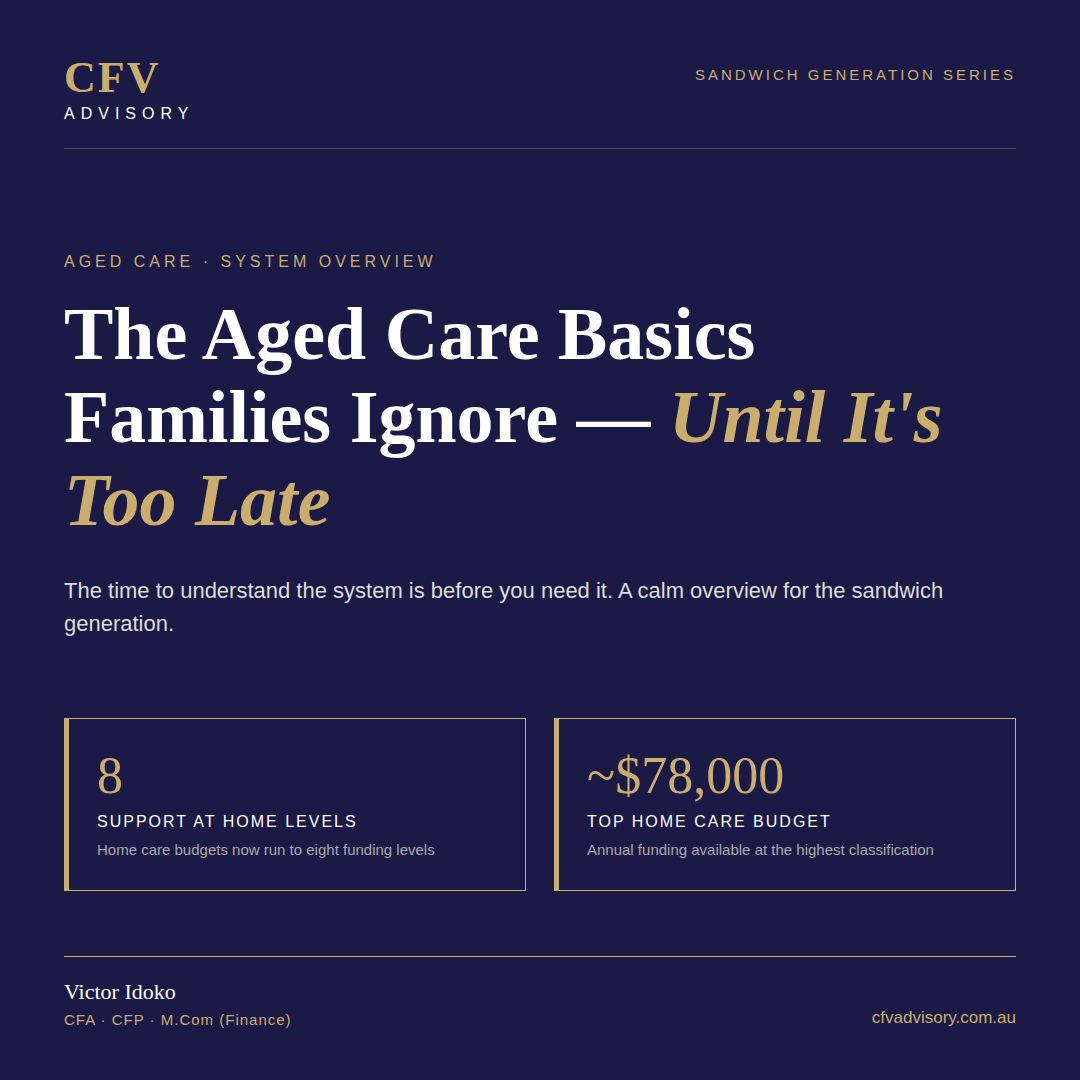
Most Australian families learn the aged care basics in a hospital corridor, under pressure, with days to decide. However, the system rebuilt itself on 1 November 2025 — and understood calmly, it’s far more navigable than it looks. The time to understand it is before you need it.
Aged care has a reputation problem. It sounds like paperwork, jargon and grief, so families postpone it indefinitely. As a result, the first real contact with the system usually happens mid-crisis, when nobody can think straight.
Yet the aged care basics fit on a single page. There’s one front door, two main types of care, and a handful of costs with hard caps on most of them. Moreover, the new Aged Care Act 2024 replaced decades of accumulated complexity with a cleaner, rights-based structure.
This article walks through those aged care basics, one page at a time. It won’t make you an expert. Instead, it will make sure that when the phone call comes — for a parent, an in-law, or eventually yourself — you already know the shape of the system.
“You don’t need to master aged care today. You just need to know the front door, the two paths, and the four costs — before the week you need them.”
The System on One Page
1. One front door
My Aged Care handles registration and a single assessment for every government-funded service.
2. Two main paths
Support at Home for care in your own home, or residential aged care when home is no longer safe.
3. Capped costs
Means-tested contributions apply, but clinical care is government funded and key fees carry hard caps.
01Aged Care Basics Start with One Front Door
Everything government-funded begins at My Aged Care — the website and phone line that registers your parent and books an assessment. Since November 2025, a single assessment pathway covers all services, from a weekly cleaner to a nursing home place.
Two practical points matter here. First, assessments and services take time to arrange, so the right moment to register is when needs are emerging, not once they’re urgent. Second, an assessment commits you to nothing. It simply puts funding approval on the shelf, ready for the day it’s needed.
02Care at Home: The Support at Home Program
Most older Australians want to stay home, and the system now leans the same way. The Support at Home program replaced Home Care Packages on 1 November 2025. It funds nursing, personal care, cleaning, transport, equipment and home modifications.
Funding comes in eight classification levels, with annual budgets running from around $11,000 to around $78,000. Additionally, clinical care — nursing and allied health — is fully government funded. Means-tested contributions apply only to independence and everyday living services, and pensioners contribute on gentler terms.
One reassurance for families already in the system: a “no worse off” principle protects people who held or were approved for a package before the changeover. Consequently, nobody should abandon existing arrangements out of fear of the new rules.
03Residential Care: Four Costs, Not One
When home is no longer safe, residential care takes over. The sticker shock usually comes from the accommodation price — rooms can now be advertised up to a cap of around $760,000 (indexed). However, that headline number is refundable, and it’s only one of four distinct costs.
1.Accommodation. Paid as a refundable lump-sum deposit (RAD), a daily payment (DAP), or a mix. For new residents, providers retain 2% of a RAD per year, for up to five years.
2.Basic daily fee. A standard fee every resident pays towards daily living, set as a percentage of the Age Pension.
3.Hotelling contribution. A means-tested contribution towards catering, cleaning and utilities, capped at around $12.55 a day (indexed). Many pensioners pay nothing.
4.Non-clinical care contribution. Means-tested, and capped hard: payments stop after four years or $130,000 (indexed), whichever comes first. Clinical care itself remains government funded.
In short, the frightening numbers have ceilings. Once you know the caps, you can model the worst case — and the worst case is almost always smaller than the family feared.
04Means Testing and the Family Home
Contributions are set by a means assessment of income and assets through Services Australia. This is where families make their most expensive mistakes, usually by acting before understanding the rules.
The family home is the classic example. Only a capped portion of its value counts in the residential means test. Furthermore, it’s exempt entirely while a protected person — such as a spouse — still lives in it. Therefore, selling the home in a panic to fund a deposit can worsen both the means test and the Age Pension position.
The broader principle: which asset funds care, and in what order, changes the outcome. Super, investments, rent and home equity each interact differently with the assessment. That’s also why asset liquidity matters long before care does — a RAD is a large cheque to write from an illiquid portfolio.
05Five Aged Care Basics to Sort Before Any Crisis
Finally, the homework. These five aged care basics cost little, and each one converts a future emergency into a manageable step.
✓Enduring power of attorney and guardianship — signed while your parents have full capacity.
✓Current wills and an advance care directive — so medical and estate wishes are written down, not remembered.
✓A one-page financial map — super, home, investments, income, debts, and where the documents live.
✓An early My Aged Care registration — once needs first emerge, so approval is waiting when it’s wanted.
✓The family conversation — what independence means to them, and who speaks for them if they can’t.
Notice what isn’t on the list: choosing a facility, selling assets, or making irreversible calls. Those decisions belong later, made calmly, with current numbers and trusted advice alongside.
The aged care basics, in four numbers
If your parents are in their 70s, put thirty minutes in the calendar this month. Walk through the five-item checklist together, then file this article where the family can find it. Ultimately, understanding the aged care basics now is what turns a future crisis into a plan you simply take off the shelf.
Prefer to listen? Catch this episode on the Two Incomes, One Plan podcast.
Victor Idoko
CFA · CFP · M.Com (Finance) — Founder, CFV Advisory
Victor helps Australian dual-income professional couples turn strong incomes into lasting wealth. He is the author of 7 Basic Wealth Strategies and host of the Elevate Your Wealth podcast. View More from CFV and Victor
Understand it before you need it.
The system is navigable — but the means testing, the RAD decision and the family home rules reward getting the sequence right. CFV Advisory helps families model it before the pressure arrives.
This article contains general information only and does not consider your objectives, financial situation or needs. It is not personal financial, legal, tax or aged care advice. Figures reflect rules current at the time of writing and are subject to indexation and legislative change. Consider seeking advice from a licensed financial adviser before acting. Victor Idoko is an authorised representative of CFV Advisory. cfvadvisory.com.au