
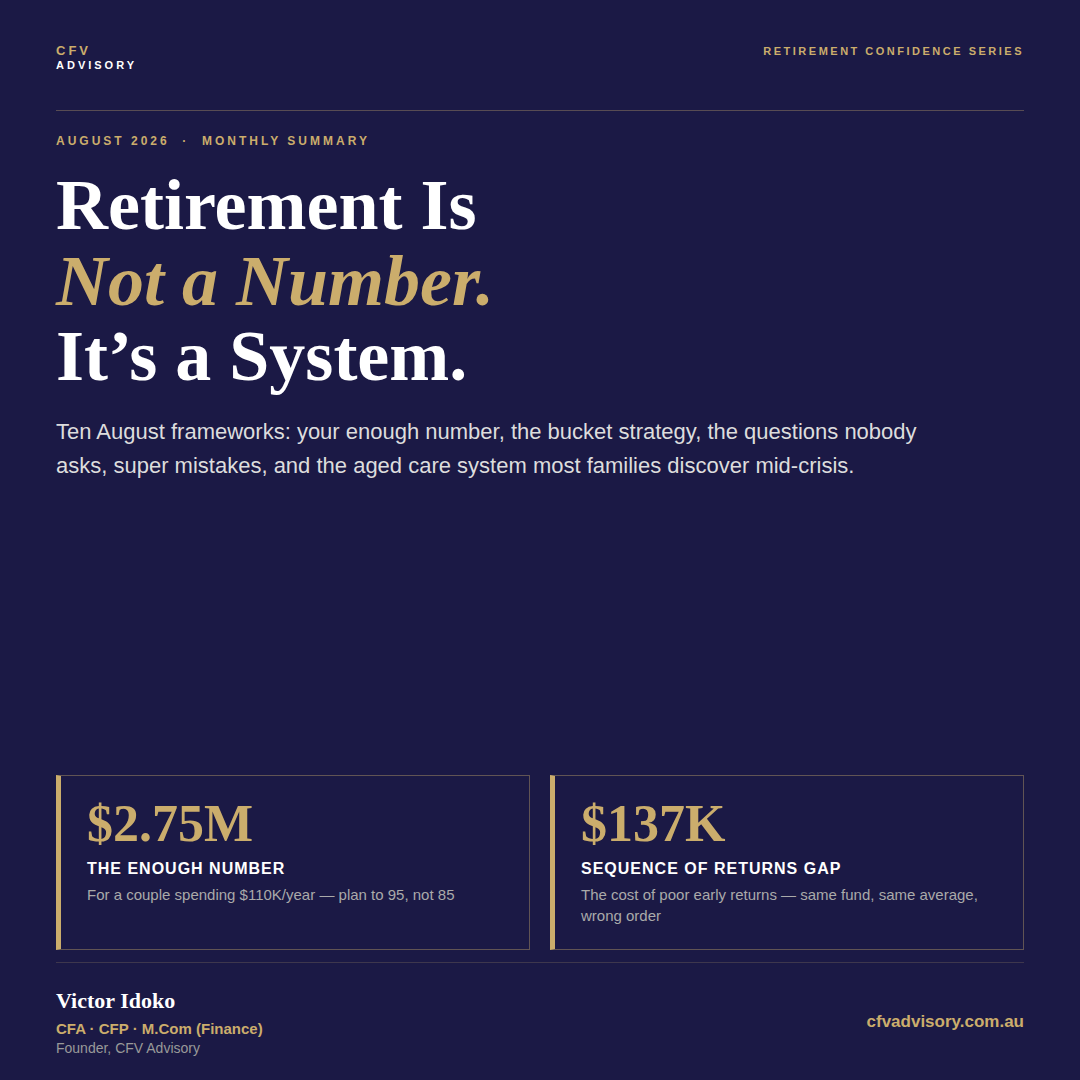
Most Australian professionals describe their super fund when asked about their retirement plan. That is not a retirement plan — it is one tool doing a job it was never designed to do alone. This August, we spent a month unpacking what a complete plan actually looks like.
The retirement question most couples avoid is not “how much do we need?” That one feels manageable, at least in theory. The questions that stay in a mental drawer for a decade are harder: What if I outlive my money? What happens when one of us dies? Can we actually stop at 55? And what do we do when mum needs care?
This August, CFV published ten articles across four connected themes — the retirement planning sequence, the bucket strategy that protects income when markets fall, the super mistakes quietly costing high-income households, and the aged care system that most families only discover mid-crisis. This article brings the whole month together in one place.
According to Adviser Ratings’ 2025 research, 57% of Australians worry about tax on wealth transfer and 30% fear family conflict at retirement. Almost none have had the conversation. This month, we gave them the numbers to start.
“Super is the most tax-effective tool most Australians will ever access. It is also not a retirement plan. A plan has income, a structure to protect it when markets fall, and a care strategy for the decade nobody wants to think about. Super is one input. The plan holds all of them.”
August at CFV — Retirement Confidence
Ten articles. Four themes. The complete picture of what retirement actually requires.
Super Is a Tool — Not a Retirement Plan
Super is the most tax-effective investment vehicle most Australians will ever access. The concessional cap rose to $32,500 per person from 1 July 2026. A couple can shelter $65,000 a year at concessional rates, with contributions taxed at 15% instead of their marginal rate. For a professional earning $160,000, that is 39 cents in the dollar — every sacrificed dollar therefore keeps an extra 24 cents working. Earnings inside the fund are taxed at 15%, dropping to zero in pension phase. No other vehicle comes close.
However, super has two structural limits that make it an incomplete plan on its own. First, preservation rules lock your money away until 60 — regardless of what happens in your forties and fifties. A redundancy, a health event, an early exit from a burnout career — none can be funded from super. Second, its rules belong to the government of the day, not to you. Division 296, now law from 1 July 2026, added an extra 15% tax on earnings attached to super balances above $3 million. Most households will never reach that threshold. But the lesson applies to everyone: a plan concentrated entirely in one legislated structure is a concentration risk.
The complete system has five parts. Super maximised first — it earns the right to every other decision. Then investments outside super — accessible before 60, providing liquidity when the unexpected arrives. Then the home, which functions as both a capital asset and a future fallback (downsizing or the Home Equity Access Scheme). Then income protection and life insurance — because the plan only works if both incomes survive long enough to build it. Finally, an estate structure that ensures what is built actually reaches the intended hands. Super is input one. The plan holds all five.
Your Enough Number — and the Bucket Strategy That Protects It
Most couples reach fifty having never calculated their retirement number. Not because it is hard — it takes twenty minutes on a bank statement. But because nobody told them it was that simple, and the financial industry spent three decades implying it required a licence, a login, and a lengthy questionnaire.
The Twenty-Minute Method — Five Numbers
Sequence of Returns Risk — The Risk Nobody Explains
Two Australians retire on the same day with $1,000,000 each. Both withdraw $60,000 a year. Both experience the identical five-year sequence of returns — but in opposite orders. The one who gets the bad years first finishes $137,600 behind after just five years. Nothing else differs. Same fund, same withdrawal, same average return. Only the order of good and bad years changed. That gap keeps widening for the next two decades because the second retiree compounds from a larger base.
This is sequence of returns risk — the least understood idea in Australian retirement planning and the one that does the most damage. When you withdraw money from a falling portfolio, you sell more units to raise the same dollars. Those units are gone permanently. They cannot participate in the recovery. The question is not whether markets will fall in your first years of retirement. They will. The question is whether you are forced to sell when they do.
The Bucket Strategy — Three Jobs, One Portfolio
The bucket strategy is the simplest defence against sequence of returns risk. It does not change what your portfolio earns. It changes what you are forced to sell, and when. For a couple retiring with $1.4 million in super, that distinction can shield seven years of spending from a market they cannot control.
These are not three separate accounts at three different institutions. They are three investment allocations sitting inside the same account-based pension. Splitting money across multiple funds creates duplicate fees, administrative drag, and can complicate transfer balance account reporting. One account with three sleeves is almost always the cleaner build. The critical point is that when markets fall in year two of retirement, the couple above draws from Bucket 1 — which hasn’t moved. Bucket 3 is left completely alone to recover. That is the whole mechanism.
The Retirement Questions Nobody Asks — Answered
Professionals are used to being competent. Admitting you do not know when you can access your own super — or whether you will pay tax on it — feels uncomfortable. So the questions stay in a mental drawer for a decade. Then, at 52 or 55, they all come out at once. Here are the five that surface most consistently, with the plain 2026 answer for each.
When can I actually access my super?
Simple answer: At 60, if you have stopped working. At 65, regardless. Preservation age is now 60 for everyone. Once you turn 60 and leave a job — even if you start another — your entire balance becomes accessible as a lump sum or pension. At 65, you can be working full time and draw freely. There is also a transition-to-retirement pension from 60, which allows up to 10% of your balance per year while still working — useful for cutting hours without cutting income, but not full access.
The trap: “Stopped working” is a legal test. Reducing hours does not count. Resigning from one employment arrangement after 60 does.
How much can I contribute per year?
Simple answer: $32,500 before tax. $130,000 after tax. Before-tax (concessional) contributions include your employer’s 12% plus salary sacrifice or personal deductible contributions — taxed at 15% inside the fund instead of your marginal rate. If your income plus contributions exceeds $250,000, Division 293 applies and the rate rises to 30%. Additionally, if your total balance is under $500,000, you can carry forward unused cap from the previous five years — allowing contributions of $60,000-plus in a single year.
The opportunity: Catch-up contributions are one of the most underused levers in Australian retirement planning. A professional who under-contributed for three years can often supercharge a single year’s contribution significantly.
What happens to our plan when one of us dies?
Simple answer: Three things change at once — and most couples have not prepared for any of them. First, the household loses one Age Pension entitlement. The single rate is roughly two-thirds of the couple rate, yet fixed costs barely fall. Second, super has to move. A death benefit paid to a spouse is tax-free — but how it moves matters. A reversionary pension keeps the income stream running automatically. Without a reversionary nomination or a valid binding death benefit nomination, the fund’s trustee decides, and the survivor waits. Third, the transfer balance cap means the surviving partner cannot simply absorb the deceased’s entire pension balance into their own cap. Careful estate structuring — done before, not after — changes everything here.
The action: Check your binding death benefit nomination tonight. If it is more than three years old, it may have lapsed. If it names a former partner, it remains valid until revoked.
Will we qualify for the Age Pension?
Simple answer: Probably some. For a couple, the full Age Pension requires assets below $470,000 (excluding the home, under 2026 thresholds). Most professional couples will be above that — but the part pension phases out gradually, and many households assume they qualify for nothing when they actually receive a meaningful partial entitlement. The Age Pension is load-bearing in retirement modelling — not a fallback but a genuine income stream worth up to $42,000 a year for a couple at the full rate, fully indexed.
The trap: The deeming rate freeze ended 20 September 2026. The lower rate moved to 1.25% and the upper to 3.25%. If you hold financial assets, the income test calculation has changed — and your Centrelink entitlement with it.
Can we actually retire before 60?
Simple answer: Yes — but the plan looks fundamentally different. Super is locked until 60, so the early years must be funded entirely from outside-super assets: investments, cash, and potentially the Home Equity Access Scheme. The couple retiring at 55 needs a bridge portfolio large enough to fund five or more years of spending independently of super. That bridge is built in the decade before exit, not in the year of it. For our benchmark household spending $110,000 a year, a five-year bridge requires approximately $550,000 in liquid, accessible assets — in addition to the $2.75 million retirement number. This is why the “enough number” and “when to stop” questions cannot be separated.
Aged Care — The System Most Families Only Discover Mid-Crisis
Here is how aged care planning usually happens. Mum has a fall on a Tuesday. By Friday, the hospital wants a discharge plan. Suddenly a family is googling the system from a corridor, making decisions worth hundreds of thousands of dollars in days rather than months. For dual-income couples in their 40s, this lands at the worst possible time — mid-career, mid-mortgage, mid-school-fees — with parents now in their 70s, exactly the decade when care needs begin.
The good news: the system rebuilt itself on 1 November 2025 when the Aged Care Act 2024 commenced, replacing legislation from 1997. Almost every rule parents’ friends remember is now out of date. Understood calmly, the new system is more navigable than it looks.
The New System — Three Changes That Matter
Why Planning in Your 40s Is Worth Thirty Years of Optionality
If you are 45, your parents are likely 70 to 80 — exactly the decade when care conversations become necessary. The decisions that shape your parents’ experience — home care versus residential, RAD deposit versus daily accommodation payment, keep or sell the family home — now move real money. Under the new system, people with means contribute more. Getting those decisions right in advance rather than under pressure is worth substantially more than any return you can earn on the funds involved.
Additionally, planning early in your 40s also builds the template for your own care three decades from now. The structural decisions you make for your parents — power of attorney, enduring guardianship, financial authority documents — are the same decisions your children will need for you. Getting them in order now costs almost nothing. Getting them in order mid-crisis costs whatever the crisis demands. For more on structuring this correctly, see our detailed articles on building retirement confidence and super transfer balance caps for pre-retirees.
Four Actions Before the End of September
The new financial year is the right moment. Here is where to start:
Prefer to listen? Catch this episode on the Two Incomes, One Plan podcast.
Victor Idoko is the founder of CFV Advisory and author of 7 Basic Wealth Strategies. He hosts the Elevate Your Wealth podcast and works with dual-income Australian households to build retirement systems that are genuinely complete — not just a super balance with a date attached.
Book Your Complimentary Introduction with Victor
In 30 minutes, we’ll map your household’s retirement position — your enough number, your super structure, your income protection, and what your plan looks like when markets fall. No product recommendations. No obligation. Just clarity on where you actually stand.
No obligation · No product push · Just a clear, honest conversation about your household
General Advice Disclaimer: The information in this article is general in nature and does not take into account your personal objectives, financial situation, or needs. It is not intended to constitute personal financial advice. Before acting on any information in this article, you should consider whether it is appropriate to your circumstances and seek advice from a licensed financial adviser. Victor Idoko is an Authorised Representative of a licensed Australian Financial Services Licensee.