
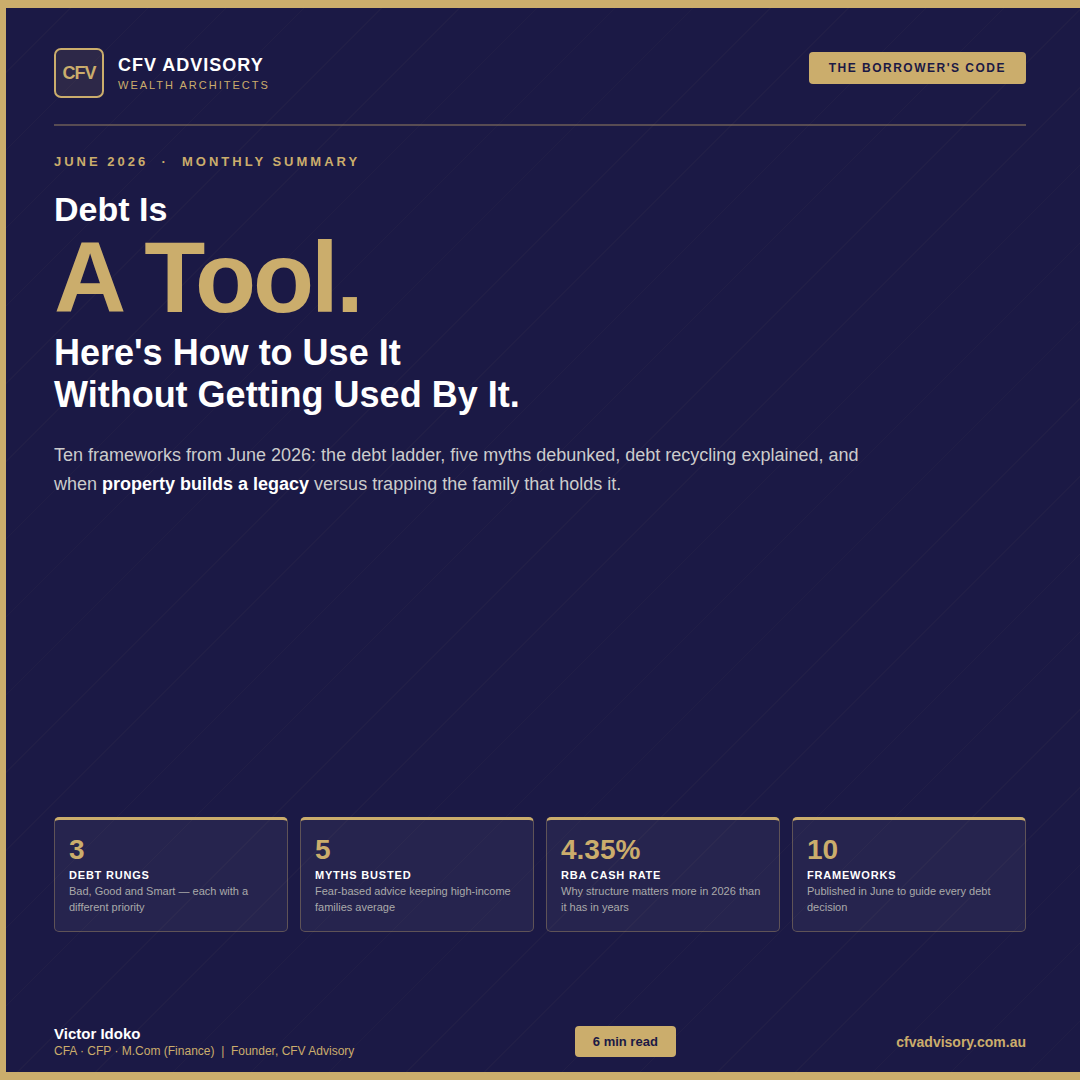
Debt built Australia’s wealth. Debt also quietly drains it — when the wrong kind is held in the wrong structure, without a set of rules to protect the household underneath it. This June, we published ten frameworks to help dual-income families tell the difference.
With the RBA cash rate at 4.35% following three consecutive rises in 2026, the cost of carrying the wrong debt has never been more tangible. Furthermore, roughly 1.6 million Australian households are now under mortgage stress — and high-income earners are not immune. The families most exposed are often the ones who borrowed well, bought good assets, and simply never built the structure to hold them through a cycle.
The ten articles we published this month form one coherent argument: debt is not the enemy. Unstructured debt is. This article brings the whole month together — every insight, every framework, every practical step — in one place.
“A loan without rules is just risk with a repayment schedule attached. A loan governed by a few non-negotiable rules becomes a tool — one you control, rather than one that quietly controls your household.”
June at CFV — The Borrower’s Code
Ten articles. Four themes. One framework for using debt to build wealth.
The Debt Ladder: Bad, Good, and Smart
The first test in any debt decision is simple: does the borrowed money produce something, or does it consume something? That single question separates the three rungs of the debt ladder — and most Australian families never make it past the second.
On a benchmark $280,000 household, bad-debt interest typically runs ~$375 per month — $4,500 a year buying no future asset. That’s not recklessness. It’s structural. Small balances across several accounts, each feeling harmless on its own. Additionally, clearing bad debt at the current cash rate earns a guaranteed return that is now meaningful — prioritising this rung first has never been more financially sound.
The home loan is good debt — necessary, manageable, and the foundation of nearly every wealth strategy that follows. What keeps it working is structure: an offset account reduces the interest you pay while keeping your cash accessible, and a debt recycling strategy gradually converts non-deductible home loan interest into deductible investment loan interest — without adding a single dollar of extra debt. That transition from good debt to smart debt is the bridge most Australian families never cross.
Five Debt Myths Keeping Australian Families Average
Fear-based money advice has a real cost. The most expensive debt myths in Australia aren’t the ones that bankrupt you — they’re the quiet ones that keep a $280,000 household merely comfortable when it could be building genuine wealth. Each myth feels like wisdom. That’s exactly why it’s so costly.
Myth 1: “All debt is bad”
This conflates a 22% credit card with a 6.2% home loan behind an appreciating asset. They are not remotely the same threat. One compounds against you violently. The other, structured well, becomes the engine of your wealth. Context beats the slogan every time.
Myth 2: “Pay off the mortgage completely before investing”
The problem is time. The years you spend waiting to be debt-free are the same years compounding does its heaviest lifting — and you can’t buy them back at any price. Extra mortgage repayments earn a guaranteed return equal to your mortgage rate (~6%). A diversified growth portfolio has historically returned closer to 8–10% per annum over long periods. Forfeiting that gap — year after year on a growing base — is one of the most common silent wealth losses in high-income Australian households. The smart move is rarely either/or. It’s structured both.
Myth 3: “Borrowing to invest is the same as gambling”
Borrowing $40,000 for a depreciating car is consumption. Borrowing against home equity to buy a diversified, income-producing asset — with a buffer behind it — is strategy. One is the casino. The other is how most serious Australian wealth was built.
Myth 4: “Negative gearing is a loophole”
It’s not a loophole — it’s the ordinary rule that you can deduct the cost of earning assessable income. It applies to both property and shares. Used well, it’s a legitimate lever in the accumulation years for higher-income earners with genuine buffers. Used carelessly, it’s a way to lose money with a tax discount. The structure is everything.
Myth 5: “Being debt-free is the goal”
You can be entirely debt-free and asset-poor. You can also carry significant structured debt and be genuinely wealthy. The actual goal is net wealth and reliable cash flow — and being debt-free is neither necessary nor sufficient for either. Clearing bad debt absolutely is a goal. Refusing to ever take on smart debt means optimising for a feeling rather than an outcome.
Debt Recycling — The Mechanism and the Suitability Test
Debt recycling is one of the most powerful wealth tools available to Australian homeowners — and one of the easiest to get badly wrong. Understanding the difference starts with the mechanism.
How It Works
One quirk of the Australian tax system does the heavy lifting: interest on the loan for your own home is not deductible, but interest on a loan used to buy income-producing investments generally is. Debt recycling exploits that gap deliberately, one step at a time:
Over time, your home loan shrinks while your deductible investment loan — and your portfolio — grows. You are not borrowing more overall. You are reshaping the debt you already carry so it starts working for you. That is the whole point.
Who It Suits — And When It Doesn’t
Debt recycling rewards a very specific kind of household — and quietly punishes the rest. At a cash rate of 4.35%, the gap between households who can do this safely and those who cannot has widened considerably.
Additionally, ownership structure matters. For couples, holding the investment in the higher-earning partner’s name is often the starting point — because the deduction is worth most where the marginal rate is highest. However, CGT on exit, income splitting, asset protection, and succession planning all create exceptions to that default. This is precisely where professional advice pays for itself.
Property — Asset or Trap? The Two Questions No One Asks
Investment property carries enormous emotional weight in Australia. For most professional couples, the first property feels like proof that the plan is working. However, an Australian property legacy is not the same thing as owning property. One compounds across generations. The other demands your salary, year after year, to stay afloat.
In the current rate environment, two questions decide everything about an investment property. Most people never ask either of them — certainly not at the open home.
What Makes Property a Legacy, Not a Liability
According to the Adviser Ratings 2025 industry report, preserving family wealth across generations is among the top concerns advisers hear from clients — cited by more than half of those surveyed. A genuine property legacy passes three tests:
The borrowing rules that protect a property legacy are the same ones that protect any debt position: a genuine cash buffer, a rate stress test completed before committing, and a written plan for what happens if one income stops. For more on the property vs shares question, and how to position both in a family portfolio, see our articles on using home equity to invest and renting vs buying in Australia.
The Borrower’s Code — Four Rules to Apply This Week
These aren’t restrictions on what your family can do. They’re the guardrails that let you move fast without leaving the road:
Prefer to listen? Catch this episode on the Two Incomes, One Plan podcast.
Victor Idoko is the founder of CFV Advisory and author of 7 Basic Wealth Strategies. He hosts the Elevate Your Wealth podcast and works with dual-income Australian households to build wealth without recklessness — just structure.
Book Your Complimentary Introduction with Victor
In 30 minutes we’ll map your household’s debt position, identify which rung each debt sits on, and show you exactly what a structured approach would mean for your family’s wealth. No product pitch. No obligation.
No obligation · No product push · Just a clear conversation
General Advice Disclaimer: The information in this article is general in nature and does not take into account your personal objectives, financial situation, or needs. It is not intended to constitute personal financial advice. Before acting on any information, you should consider whether it is appropriate to your circumstances and seek advice from a licensed financial adviser. Victor Idoko is an Authorised Representative of a licensed Australian Financial Services Licensee.