
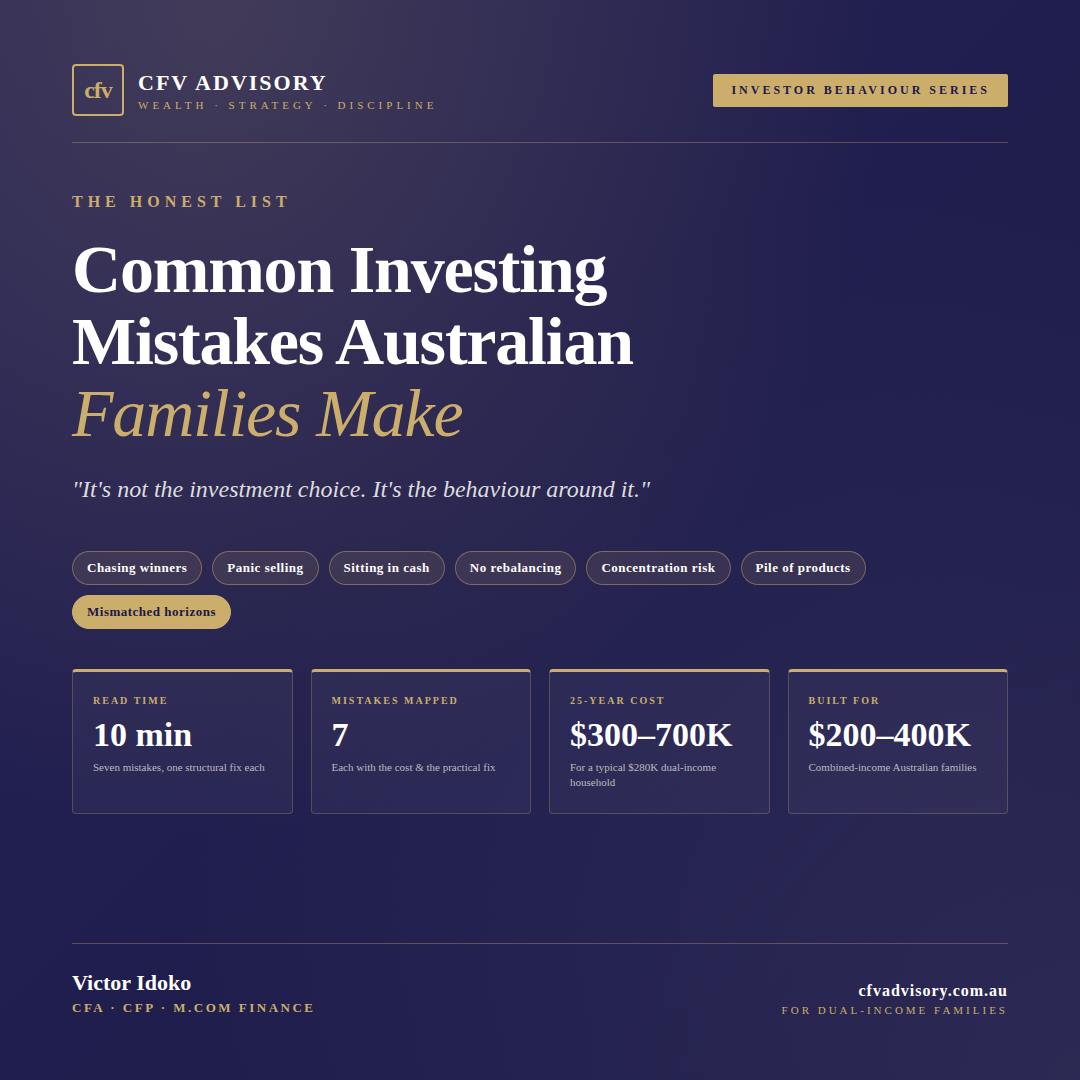
The most expensive common investing mistakes Australian families make rarely involve picking the “wrong” fund. They involve doing the right thing at the wrong time, or doing nothing when something simple and structural would have changed the outcome by hundreds of thousands of dollars.
If you sit across the desk from enough households earning $200,000–$400,000 combined, you start to notice that the common investing mistakes are remarkably consistent. The fund choices vary. The platforms vary. The income levels vary. But the seven errors below show up again and again, regardless of how sophisticated the household looks on paper.
None of these mistakes are about being reckless. As a result, the article isn’t moralistic — it’s structural. Each of these patterns happens because human brains, busy schedules and Australian financial product design quietly nudge you towards them. To put it plainly, the answer isn’t to try harder. It’s to design the system so the mistake stops being available.
Here are the seven common investing mistakes we see most often in Australian dual-income households — and the practical fix for each.
A fund returns 38% in a calendar year. The financial press celebrates. Inflows surge. New investors pile in — usually right at the top. The fund cools off, returns 4% the following year, and most of the new money quietly underperforms what it would have earned in a boring index.
For instance, in 2026 the conversation is AI funds, mining (with materials up 52% year-on-year heading into the rate cycle), and uranium. Five years ago it was global tech. Five years before that, emerging markets. The pattern is identical, only the labels change.
Why it happens: recency bias. Whatever just happened feels like what’s coming. Headlines reinforce it, group chats compound it, and your brain treats “lots of mentions” as evidence.
This is the single most expensive of the common investing mistakes — and Australia has documented evidence. During the COVID-19 sell-off in March 2020, APRA-regulated super funds returned approximately −10.3% for the quarter. Hundreds of thousands of Australians switched from balanced or growth options into cash, locking in the loss exactly as the recovery began.
For the system as a whole, member-driven switching into cash represented around 1.5% of funds under management; for some larger funds it was 3–4%, with one mid-sized fund seeing 8%. The Super Members Council estimates an Australian who switched $100,000 into cash at the COVID-19 low was around $50,000 worse off five years later than someone who stayed put.
Why it happens: loss aversion. A 20% paper loss feels roughly twice as painful as a 20% gain feels good. Doing something — anything — feels like control. Unfortunately, the “something” is usually the most expensive thing you can do.
This is the same mistake as panic-selling, but quieter and more socially acceptable. Money sits in a high-interest savings account or term deposit “for now” — except “for now” stretches into three years, then five, then seven. Meanwhile, inflation does its work in the background.
Even at the current RBA cash rate of 3.85% (with savings accounts paying around 4–5%), the long-run real return on cash after tax and inflation is close to zero, and often negative for households in the 37% or 45% marginal tax brackets. By contrast, the AustralianSuper Balanced option returned 8.21% per annum over the 10 years to December 2025 — through GFC, COVID, the inflation cycle and the geopolitical noise.
Why it happens: cash feels safe because it doesn’t move. However, in real terms (after tax and inflation), excess cash is one of the riskiest places to keep long-term money. The risk just doesn’t show up on a statement.
A household sets a portfolio at 70% growth / 30% defensive. Five years later, growth assets have run hard and the mix is now 84% growth / 16% defensive — a meaningfully more aggressive portfolio than the one they originally agreed to. They didn’t choose that risk level. They drifted into it.
Then a downturn hits, and the household discovers — at the worst possible moment — that they’re more exposed than they thought. The panic in mistake #2 follows naturally from the neglect in mistake #4.
Why it happens: rebalancing is unsexy. It rarely makes a headline. Above all, it forces you to sell what’s been winning and buy what’s been lagging — which feels emotionally backwards, even though it’s structurally exactly right.
Three patterns we see constantly in Australian dual-income households: 40% of net worth in the family home with another 30% in an investment property (one asset class, two doors); large RSU or ESPP positions in a single tech employer that have grown into 25–35% of liquid wealth; or super, ETFs and personal stocks all heavily weighted to the ASX 200 banks and miners (which collectively run the show on the local index).
For instance, a household with a $1.2m PPOR, a $900K investment property, $400K in super (mostly ASX-tilted) and $250K in CBA shares looks diversified on paper. In practice, almost everything they own is leveraged to Australian housing and Australian banks. One credit cycle and three of those exposures move together.
Why it happens: concentration feels like conviction. The asset that built your wealth feels permanent. Selling some of it feels disloyal — to the property, to the employer, to the past version of you who got it right.
A typical dual-income household we meet has: two industry super accounts (sometimes three from old jobs), an offset account, a CommSec or Stake brokerage, a Raiz, a Pearler, a couple of micro-investing apps, an investment property, BNPL accounts, two life insurance policies bundled with super, and possibly a vague memory of a managed fund someone’s accountant set up in 2015.
There is no plan. There is a collection. Each product made sense at the moment it was bought. As a result, none of them coordinate. Insurance is duplicated, super is fragmented, and the brokerage account is doing the same job (large-cap Australian shares) as part of the super.
Why it happens: financial products in Australia are sold one at a time. Super is sold by employers, ETFs by platforms, insurance by aggregators, property by buyers’ agents. No one is paid to look at the whole picture. Consequently, you end up with a portfolio that nobody — including you — has ever assembled deliberately.
This is the most subtle of the common investing mistakes, and one of the most expensive: putting long-term money in short-term containers, and short-term money in long-term ones.
For example, a 35-year-old with super in a “Cash” or “Capital Stable” option is investing 30-year money like it’s needed next month. On the other hand, a household saving for a deposit in 18 months that has the deposit savings in 100% growth ETFs is investing short-term money in a long-term container — and a 20% drawdown in the wrong quarter is the difference between buying the house and renting another year.
Why it happens: most people pick an investment based on what they’re comfortable with emotionally, not what the money’s job actually is. Comfort and time horizon are different problems.
Every one of these common investing mistakes has the same root: a moment of decision-making that should never have been a fresh decision. Chasing a winner, panicking in a downturn, defaulting to cash, skipping a rebalance, sitting on a concentrated position, accumulating products without a plan, or investing money outside its time horizon — each one happens because there was no rule already in place.
As a result, the household is forced to make the call in real time, under emotional load, with imperfect information. That is exactly the wrong moment to decide. Crucially, the fix in every case is structural: write the rule once, when you’re calm, and let the rule run the portfolio.
Avoiding common investing mistakes is a system, not a willpower problem
If your portfolio is currently doing some version of three of the seven mistakes above — and most are — that’s not a character flaw. It’s a design flaw. Australian financial product distribution actively pushes households toward fragmentation, performance-chasing and short-termism. The household that quietly outperforms isn’t smarter; they’ve just removed those nudges from their environment.
If you have children, the most generous gift is to inherit a household where these structural decisions were made early. For a gentler entry point on teaching the next generation about money, our co-authored children’s series Bunnies & Monies introduces these concepts at age-appropriate levels — the same principles, fifty years earlier.
Prefer to listen? Catch this episode on the Two Incomes, One Plan podcast — the audio version of this article. Victor also covers wealth-building foundations and investor behaviour on the basics of building your wealth episode of the Elevate Your Wealth podcast.
Join the CFV Advisory Waitlist →