
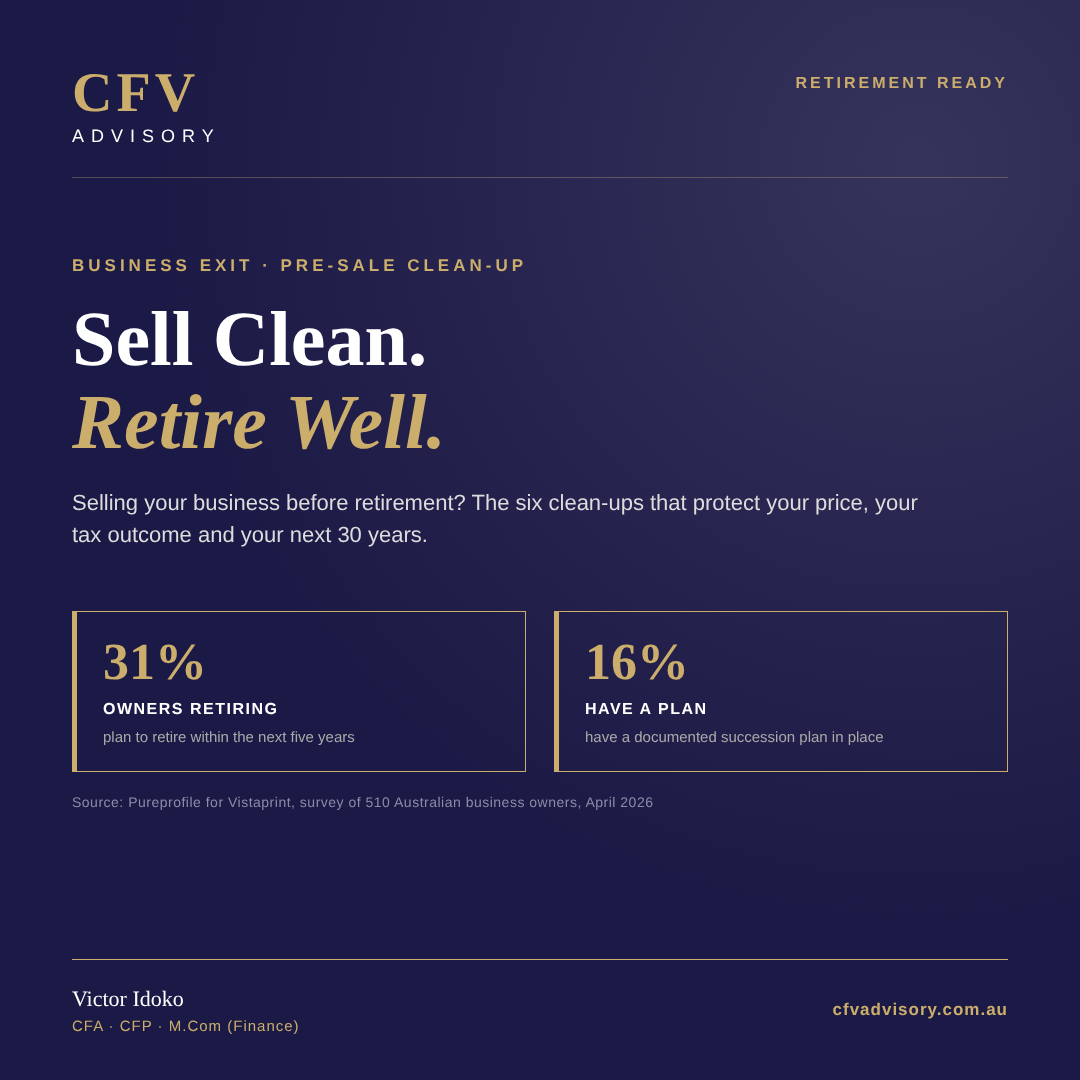
Selling your business before retirement is often the biggest financial decision you will ever make. Yet 31% of Australian owners plan to retire within five years. Only 16% have a documented succession plan.
Key Takeaways
For many couples in their late fifties and sixties, the business is more than a job. In fact, it is often the largest asset you own. As a result, the sale price quietly becomes your retirement income.
That is why selling your business before retirement feels so different to any deal you have done before. You only get one go at it. Moreover, once the contract is signed, most of the big decisions cannot be undone.
The good news is simple. Buyers pay more for businesses that are easy to understand. Similarly, the tax system rewards owners who plan ahead. You have already done the hard part. Now the job is making sure you get to enjoy it.
“In almost every exit conversation we have, the owner has thought hard about the sale price. Far fewer have thought about the day after settlement. The price matters, but the plan for the money matters more.”
— Victor Idoko, CFA, CFP
Why 2026 is a crowded year to sell a business
More owners are heading for the exit at the same time, so buyers can afford to be choosy. In April 2026, a survey of 510 owners by Pureprofile for Vistaprint was published. It found 31% plan to retire within five years. However, 45% of owners considering an exit have no succession or sale plan at all.
Put simply, a lot of businesses will reach the market together. Consequently, the clean, well-documented businesses will sell first, and at the better prices.
On top of that, Payday Super started on 1 July 2026. It means employers must now pay staff super with wages, not quarterly. According to the Fair Work Ombudsman, it must reach the fund within seven business days of payday. Buyers will check this closely, because any shortfall becomes their problem.
Make the business financials easy to believe
Clean, verifiable accounts are the single biggest lever you control on your sale price. That is because buyers usually value a small business on a multiple of maintainable profit. Maintainable profit is the profit a buyer expects the business to keep earning once you have gone.
For owner-operated firms, a commonly quoted rule of thumb is two to four times that profit. The real multiple varies widely by industry, size and risk. Even so, every dollar of profit a buyer can verify may be worth several dollars at sale.
Here is where many owners trip up. Over the years, personal costs drift into the business. For example, the family car, phone plans, or a spouse’s wage for light bookkeeping. None of this is unusual, and it often made sense at tax time.
However, it now works against you. Say $40,000 a year of personal spending runs through the books. At a three-times multiple, that could mean $120,000 less on the price. You can claim these as add-backs, which are personal or one-off costs added back to show true profit. Yet buyers often discount anything they cannot verify.
◆ Self-check: what buyers will ask for first
The profit a buyer can verify, not the profit you know is there, is what sets your price.
Tidy the legal loose ends before you list
Fix leases, contracts and personal guarantees before you list, because legal loose ends cost money late in a sale. Legal problems rarely kill a sale outright. Instead, they create delays, nervous buyers and last-minute price cuts.
Leases are the most common surprise. If your premises lease has 18 months left and no renewal option, a buyer may walk. Similarly, key supplier and customer contracts may need consent before they can transfer.
Also check who actually owns what. For instance, a ute may sit in your personal name. The website domain may be registered to a nephew. Small things like these slow settlement down.
Finally, list every personal guarantee you have signed. They do not end automatically when you sell. Unless they are formally released, the business’s loans, leases or supplier accounts can follow you into retirement.
◆ Checklist: the legal clean-up list
Make the release of every personal guarantee a condition of settlement, so the business’s debts stay with the business.
How much capital gains tax will I pay when I sell my business?
You may pay no capital gains tax at all if you are 55+, retiring and have owned the business for 15 years. Capital gains tax (CGT) is the tax on the profit you make when you sell an asset. When it comes to selling your business before retirement, this is where planning pays off most.
Australia’s small business CGT concessions are generous, but the conditions are strict. To qualify, the business generally needs aggregated turnover under $2 million. Aggregated turnover includes connected businesses. Alternatively, your net assets must be $6 million or less.
For that $6 million test, your home and your super generally do not count. In addition, the asset sold must be an active asset. That means it is used in running the business, not held mainly to earn rent or passive income.
Once you qualify, the concessions can work together like this:
◆ Structure and timing: the two big tax levers
Structure also matters. In a share sale, the buyer takes over your company, including its history. In an asset sale, they buy only the business assets. The tax outcome can differ significantly, so your accountant should model both.
Likewise, a business held in a family trust has its own rules on who receives the gain. Above all, timing matters. For CGT, the contract date usually decides which tax year the gain falls into. Therefore, signing in June rather than July can change your whole tax picture.
The 15-year exemption can make a seven-figure capital gain tax-free, but only if every condition is checked years ahead.
Use super to turn the sale proceeds into retirement income
For most retiring owners, super is the most tax-effective home for the sale proceeds. Leaving the money in the bank feels safe. However, interest is taxed at your marginal rate, and inflation quietly chips away at it.
Normally, after-tax money you put into super counts towards the non-concessional cap. For 2026–27, that cap is $130,000, or up to $390,000 using the bring-forward rule. Eligibility depends on your total super balance. All the caps in this section come from the Tax Institute’s 2026–27 super caps ready reckoner.
Sale proceeds are different. Amounts from the 15-year or retirement exemptions can instead count towards the CGT cap. The CGT cap is a separate lifetime limit, and for 2026–27 it is $1,935,000 per person. For the 15-year exemption, that can include your share of the capital proceeds, not just the gain.
There is a catch. You must lodge the ATO’s CGT cap election form with your fund no later than when you contribute. Miss it, and the money counts towards your non-concessional cap instead. Before-tax concessional contributions are also capped at $32,500 for 2026–27.
◆ Turning super into tax-free retirement income
Once in super, you can start an account-based pension. At that point your super is in retirement phase, where earnings are generally tax-free. The transfer balance cap is the lifetime limit on what you can move into retirement phase. For 2026–27, it is $2.1 million per person.
Super does have trade-offs. Generally, you can only access it once you retire after preservation age, or turn 65. The rules can also change. For example, Division 296 is now law.
From 1 July 2026, it adds an extra 15% tax on earnings above a $3 million balance. For couples, how you split proceeds between two super accounts now matters even more.
Getting the order, timing and paperwork right is the difference between tax-free retirement income and an avoidable bill.
◆ Worked example: how one couple’s sale could play out
Peter and Anne have run their engineering consultancy together for 22 years. They own it 50/50 in their own names and agree a $1.6 million sale. Their capital gain is $1.5 million.
Both are 55 or over, both are retiring and both pass the basic conditions. So the 15-year exemption may disregard the entire $1.5 million gain. Each receives $800,000, well within their $1,935,000 CGT cap.
With CGT cap election forms lodged, they each contribute $800,000 to super. That leaves their non-concessional caps untouched. Each now has about $1.25 million in super. That is under both the $2.1 million transfer balance cap and the $3 million Division 296 threshold.
What if Peter were 54? He could not use the 15-year exemption. Other concessions would still reduce the gain, but his retirement exemption amount would have to go into super.
Illustrative only. Figures use 2026–27 caps and assume both meet every condition. Your outcome will depend on your structure.
Untangle the household finances from the business
Use the sale to separate your household finances from the business, starting with debt, guarantees and insurance. Most owners have run both as one big cash flow for years.
Start with debt. At CFV, we think about debt in three tiers. Bad debt is consumer debt, such as credit cards, car loans and personal loans. Good debt is your home loan. Smart debt is borrowing to invest in assets that produce income, where interest is often deductible.
Before retirement, bad debt should go first. Next, aim to retire without good debt if you can, because mortgage repayments are hard to fund from a pension. Smart debt deserves a careful review. Without a salary, the maths often changes.
Insurance is the other loose end. Key person cover pays the business if someone vital cannot work. It, along with business-linked income protection, may end at settlement. Meanwhile, life cover may still matter if one partner relies on the other. So review your cover before you cancel anything.
Settlement day should make your finances simpler, not reveal a guarantee, a lapsed policy or a forgotten loan.
Plan the first two years after you sell
Plan the first two years after settlement carefully, because that is when most of the remaining risk sits. To begin with, many sale contracts do not pay everything on day one.
An earn-out ties part of the price to the business’s future profit. Vendor finance means the buyer pays you over time. Both carry risk, because your money depends on someone else running the business well.
Then there is the market. If you invest the proceeds and markets fall in year one, it hurts more than at any other time. This is called sequence risk. Consequently, we often hold one to two years of spending in cash. That way, you never sell growth assets in a downturn.
Finally, there is you. Many owners stay on for six to twelve months to hand over relationships. It reassures the buyer and protects the price. Victor talks through these questions in A Series of Questions to Guide You on the Retirement Path.
A bucket strategy turns a lump sum into reliable income: two years of cash, then steadier assets, then growth.
Who this guide does not suit
This guide is written for owners selling a business they run themselves. In particular, it may not fit you if:
If you are handing the business to family, this episode on family business succession is a better starting point.
Your pre-exit timeline: when to start preparing to sell
Ideally, selling your business before retirement starts about three years ahead. Here is how that time is best used.
What a clean exit can be worth
Selling a Business Before Retirement: Frequently Asked Questions
Do I pay capital gains tax when I sell my small business in Australia?
Usually yes, but the small business CGT concessions can reduce it a lot, sometimes to nil. To qualify, the business generally needs aggregated turnover under $2 million or net assets of $6 million or less. The asset sold must also be an active asset. Your home and super generally don’t count towards the $6 million.
What is the 15-year exemption when selling a business?
It lets you disregard the entire capital gain on an active business asset. You must have owned it for 15 years, and be 55 or over and retiring, or permanently incapacitated. Retiring means at least a significant reduction in the hours you work.
How much of my business sale can I put into super?
For 2026–27, up to $1,935,000 per person under the lifetime CGT cap. This applies to money from the 15-year or retirement exemption. You must lodge a CGT cap election form with your fund no later than when you contribute. Otherwise it counts towards your $130,000 non-concessional cap.
What is the small business retirement exemption?
It lets you disregard up to $500,000 of capital gains over your lifetime. If you are under 55, you must pay the exempt amount into super. From 55, putting it into super is optional.
How long before retiring should I start preparing my business for sale?
Ideally two to three years. That gives you time to clean up the accounts and fix leases and contracts. It also lets you check the CGT concessions early. Starting late narrows your options, especially on tax.
Should I sell my business assets or the company shares?
It depends on your structure, and the tax outcome can differ significantly. In a share sale the buyer takes over your company, including its history. In an asset sale they buy only the business assets, so your accountant should model both.
What happens to my personal guarantees when I sell my business?
They do not end automatically. Guarantees you signed for loans, leases or suppliers can stay with you after settlement unless they are formally released. Make their release a condition of settlement.
Selling your business before retirement: what to do next
Start today with the two self-checks above: the buyer’s list and the legal list. Tick what you already have, and circle what is missing. That alone tells you how much preparation time you need.
Beyond that, selling your business before retirement is a team effort. Your accountant knows the numbers and your lawyer knows the contract. However, someone needs to connect the sale to your super, your income and your family.
That is the gap we fill. We model your retirement cash flow year by year, using the real sale price and the real tax outcome. As a result, you can see whether the offer on the table is actually enough, before you accept it.
Want to go deeper first? On the Elevate Your Wealth podcast, Victor covers exit structures in What Every Business Owner Must Know. You may also find why trusted advice matters for pre-retirees useful. And if a friend is a few years from selling, this is a good article to pass on.
Victor is the founder of CFV Advisory. He helps Australian couples and business owners turn a lifetime of work into a retirement plan they can rely on. He is the author of 7 Basic Wealth Strategies and 5X Your Wealth, and hosts the Elevate Your Wealth podcast. Learn more at cfvadvisory.com.au.
In one conversation, we’ll look at your likely sale proceeds, your super and your retirement timeline. Then we’ll show you what needs to happen before you sign anything.
No obligation. No sales pressure. Don’t Wing It. Plan It.
Last updated 3 November 2026. General Advice Disclaimer: The information in this article is general in nature and does not take into account your objectives, financial situation or needs. It is not personal financial, tax or legal advice. Before acting, consider whether it is appropriate for your circumstances and seek advice from a licensed financial adviser and a registered tax agent. Small business CGT concessions have detailed eligibility rules. Examples are illustrative only. Caps and thresholds are for the 2026–27 financial year and may change. CFV Services Pty Ltd is an Authorised Representative of Spark Advisors Australia.