
Estate Planning for Australian Couples — September 2026
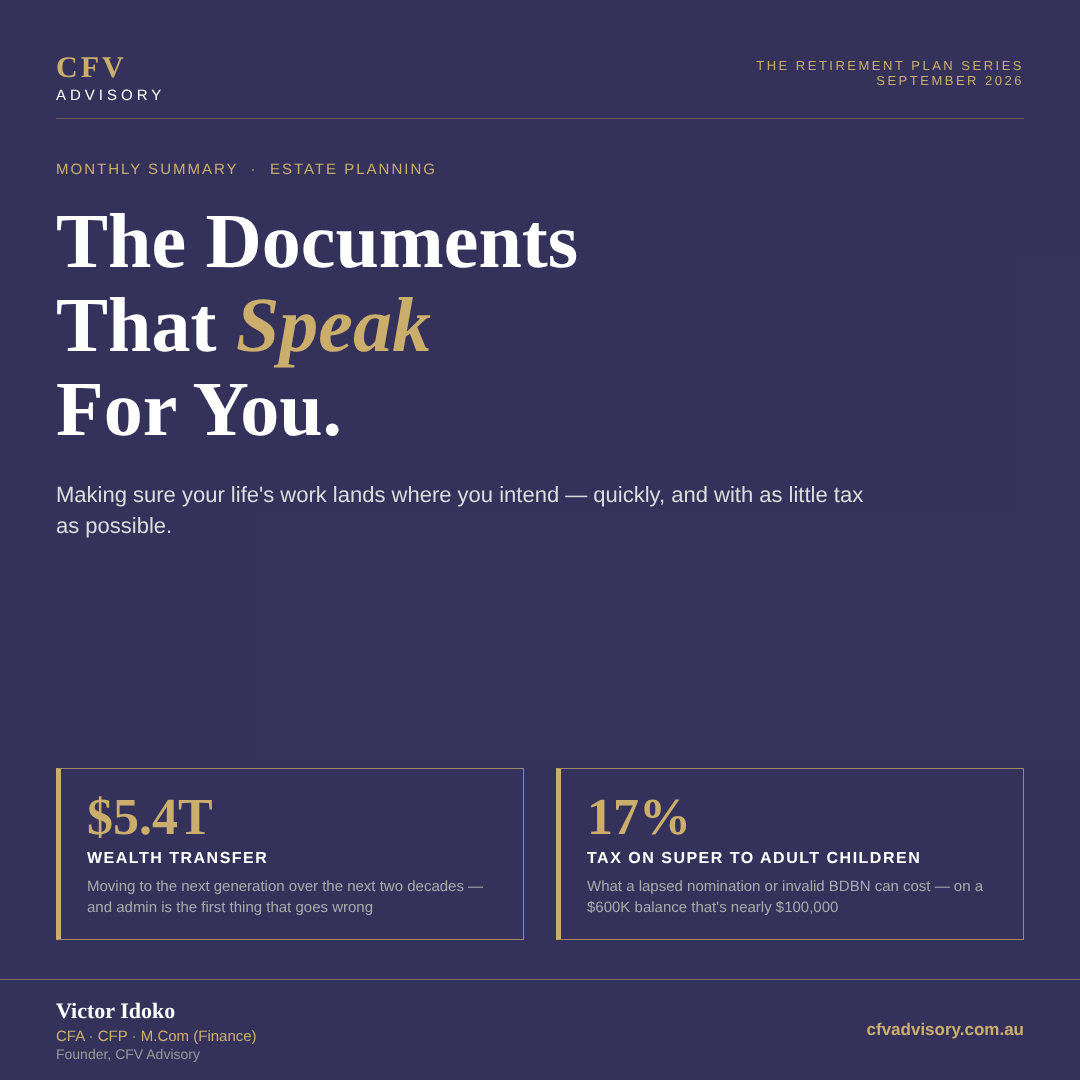
Over the next two decades, $5.4 trillion will transfer to the next generation of Australians. Most of that wealth will not be lost to bad investments or falling markets. It will be lost to admin — to lapsed nominations, to missing documents, to conversations that never happened. September’s four articles were about the part of wealth planning that nobody schedules: making sure your life’s work lands where you intend, quickly and with as little tax as possible.
“Documents allocate. Conversations explain. The explanation is the part that survives you.”
What We Covered This Month
Four articles. Four questions most Australian couples in their 50s and 60s have been meaning to address. Together, they form a single system: your estate plan is not a folder of documents — it is a set of decisions, made in the right order, explained to the right people.
1. Your Will Doesn’t Control Your Super
This is the fact that surprises almost every couple we speak with. Your will governs your estate assets — the house, the savings account, the share portfolio. It has no direct authority over your superannuation. Super is held in trust, under superannuation law, and flows according to a separate document: your Binding Death Benefit Nomination (BDBN).
Without a valid BDBN, the fund trustee decides who receives your super. ASIC confirmed in June 2026 that families wait six months or more in these cases. And when a lump sum reaches an adult child who wasn’t financially dependent on you, up to 17% in tax applies to the taxable component. On a $600,000 balance, that is close to $100,000 — paid to the ATO, not your family.
The BDBN Check — Both Partners, 20 Minutes
• Log into every super fund — confirm what nomination is recorded
• Binding or non-binding? What is the lapse date?
• Put the lapse date in your calendar as a recurring reminder
• Sit nominations beside your will — do they tell the same story?
• If either partner has an account-based pension, ask whether a reversionary nomination suits better
2. The Four Documents That Do Almost All the Work
Estate planning in your 60s is less about death and more about decisions. Four documents handle most of it. Most couples are missing at least two.
Will
Governs estate assets — but not super, jointly held property, or family trust assets. Review every three years or after major life events.
Enduring Power of Attorney
Allows a trusted person to make financial and legal decisions if you lose capacity. Without one, the family may need to apply to a state tribunal.
Advance Care Directive
Covers health and residential decisions. Names differ by state (Enduring Guardian in NSW/QLD). Short and inexpensive — yet the document most commonly missing.
Binding Death Benefit Nomination
The only document that controls super. Lapses every 3 years in most funds. Most commonly outdated after divorce or blended family changes.
Common trap: the mismatch
A couple with $1.8M in super and a jointly owned home — their will may govern only a fraction of their actual wealth. The executor is often the last role couples update, even after a divorce or adult children coming of age.
3. The Family Money Meeting
Estate planning fails most often at the communication layer, not the legal layer. The will was signed. The nomination was submitted. But nobody explained it, and the first time the family saw it was when they needed it most.
A family money meeting is a short, structured conversation — not a balance review. It answers five questions: What exists and where does it live? Who is the executor and why? Who holds the power of attorney? What are the wishes around the home and aged care? And what is one small action each person can take today?
“Equal is not always fair. Fair is not always equal. But unexplained is almost always resented.”
You do not need perfect documents to have this conversation. You need a date, an agenda, and a first sentence: “We’re not sick and nothing has changed. We’d simply rather you heard our plan from us.”
4. The Checklist: If I’m Gone Tomorrow
Families routinely spend 6–12 months reconstructing a financial life from bank statements after a sudden death — even when a valid will exists and a super nomination is in place. The problem is not the documents. The problem is that nobody knew where to start.
The 7-Part Estate Planning Checklist
1. Legal core — will, EPA, advance care directive; where are the signed originals?
2. Money map — every account, institution and contact (not balances — they go stale); include CGT cost base records
3. Super and insurance — every fund, member number, nomination type, and any insurance held inside super
4. Debt list — bad debt (cards, BNPL, car loans), good debt (home loan), smart debt (investment property loans)
5. Digital life — email access, two-factor codes; use a password manager with emergency access — never write passwords in your will
6. People to call — solicitor, accountant, financial planner, executor, insurance broker
7. Letter of wishes — not legally binding, but often the page families treasure most; explains the reasoning behind unequal gifts
Review this checklist every June alongside end-of-financial-year planning — and after any major life event.
Four Actions Before the End of October
Check both super fund nominations — confirm they are binding, current, and correctly witnessed
Locate the four core documents (will, EPA, advance care directive, BDBN) and confirm where originals are held
Block one hour for a family money meeting — write the five agenda items, not a perfect speech
Start the estate planning checklist — legal core first, then money map; tell one trusted person where it lives
On the Podcast This Month
The September episode of Two Incomes, One Plan is: “The Documents That Speak For You — Estate Planning Before It’s Urgent.” Search “Two Incomes One Plan” on your preferred podcast platform, or visit cfvadvisory.com.au.
About Victor Idoko
Victor Idoko, CFA, CFP, M.Com Finance, is the founder of CFV Advisory. He works with dual-income Australian couples on $200K–$400K to close the gap between earning well and building lasting wealth. Victor is the author of 7 Basic Wealth Strategies and Two Incomes, One Plan to 5X Your Wealth, and hosts the Two Incomes, One Plan podcast.
Ready to Make Sure Your Wealth Lands Where You Intend?
General advice disclaimer: This article contains general financial information only and does not constitute personal financial advice. Please consider your own circumstances and consult a licensed financial adviser before acting on any information in this article.