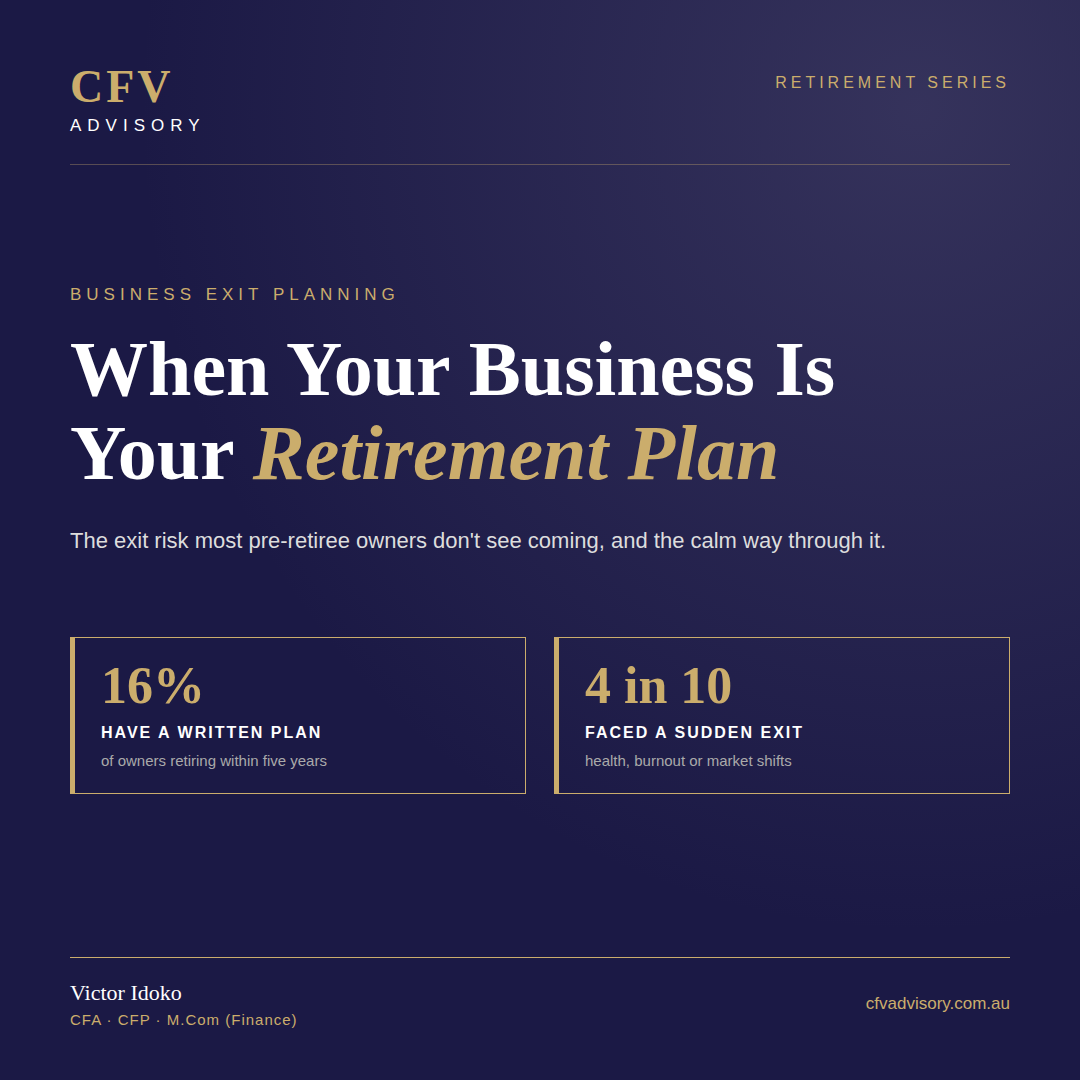
Business exit planning is the retirement task most owners leave until last. Yet it’s the one part you can’t rush. Nearly one in three Australian small business owners plans to retire within five years. However, only 16% have a documented succession plan.
If you’re in your late fifties or early sixties and own a business, you’ve done the hard part. You built something from nothing. You’ve survived downturns, staff changes and more than one tough year. As a result, the business is probably your largest asset after the home. That is exactly why business exit planning deserves the same care you gave the business itself.
Here’s the uncomfortable part. For many owners, the business isn’t just an asset. It is the retirement plan. In fact, 2026 research found 34% of Baby Boomer owners expect a sale to fund most of their retirement.
That can work. However, it only works if the sale happens on your terms, at your price and at your timing. This article explains why that’s less certain than it feels. More importantly, it shows the calm, practical steps that take the risk out of it.
Meet Peter and Anne: A Familiar Picture
Peter is 61 and Anne is 59. Peter has run an electrical contracting business for 22 years, with six staff. Anne keeps the books two days a week. Their home is worth about $1.6 million, with $90,000 left on the loan.
Their accountant reckons the business is worth around $1.2 million. Meanwhile, their combined super is $410,000, mostly Anne’s. Peter’s contributions were always going to happen “next year”. They also hold $70,000 in their offset account.
Their plan is simple. Peter works until 65, sells the business, and they retire on the proceeds plus super. On paper, they’re worth more than $3 million. So why does Anne lie awake at night? (Peter and Anne are an illustrative composite, not real clients.)
“A business is only worth what someone will pay for it, on the day you need to sell it.”
01The Concentration Risk Hiding in Plain Sight
Financial planners talk a lot about diversification. Most owners nod along, then hold most of their spendable wealth in one illiquid asset. That’s not a criticism. It’s simply how businesses get built, because every spare dollar goes back in.
Think of it this way. If 71% of a retiree’s savings sat in one listed company, any adviser would raise it. Yet a private business is usually riskier than that. For one thing, you can’t sell a slice when you need cash. You also can’t easily price it. Above all, its value often depends on the very person who wants to retire.
For Peter and Anne, this means their retirement hinges on three things they don’t fully control. Those are a buyer, a price and a date.
Net worth isn’t the number that matters in retirement. What matters is how much of your wealth can reliably pay the bills, and when.
02Why Owners Delay Business Exit Planning
If the risk is so clear, why do so many owners put this off? Usually, it isn’t denial. It’s comfort. The business is going well, the order book is full, and there’s always next year.
Furthermore, exit planning means picturing life without the thing that has defined you for decades. That’s an emotional job, not just a financial one. It’s also easy to feel that raising it with family will worry everyone.
How common is it to have no exit plan?
The numbers show how common this is. Research commissioned by VistaPrint in April 2026 found 45% of owners considering an exit have no succession or sale plan. Moreover, 19% of those planning to retire hadn’t discussed it with anyone. That means no family, no staff and no adviser.
Here’s the catch. A good year is the best time to plan an exit, not a reason to delay it. Buyers pay more for a business that’s performing and less dependent on its owner. Consequently, waiting for things to slow down often means selling at the worst point.
The comfort trap works quietly. The longer the business performs, the easier it is to postpone, and the fewer options remain when you need them.
03The Exit You Didn’t Plan For
Not every exit is chosen. The same research found four in ten owners had already left a previous business suddenly. The causes were familiar: health crises, financial pressure, burnout and market shifts.
Let’s run that scenario for Peter. At 62, he injures his back and can’t work for eight months. Several builders he’s worked with for years drift to other contractors. Then revenue falls, and two key staff leave.
When the couple finally list the business, buyers see a firm that depended on Peter. As a result, the best offer is $500,000, not $1.2 million. That’s a $700,000 gap.
If Peter and Anne planned to spend $90,000 a year, that’s nearly eight years of retirement income gone. Importantly, nothing about Peter’s skill or effort changed. Only the timing did.
The real risk isn’t that the business fails. It’s that the exit happens at the wrong moment, on someone else’s terms.
04What Your Business Is Really Worth to a Buyer
Owners often value a business by what it has cost them. That includes the years, the weekends and the stress. Buyers value it differently. In short, they pay for profit they can keep after you leave.
That’s where owner-dependence bites. The VistaPrint study found 78% of owners aged 50 and over rely mainly on personal reputation and word of mouth. That’s a strength while you’re there. To a buyer, however, it’s a risk they will price in.
For this reason, the most valuable work before a sale often isn’t growth. Instead, it’s transfer. That means documenting how things are done, building a second-in-charge and introducing key clients to the team. Put simply, a business that runs without you is worth more and gives you more choices.
Relationships that live in your head and your phone don’t transfer on settlement day. Moving them to the team is often the highest-value work left.
05The Five-Year Runway to a Calmer Retirement
The good news is that most of this risk is manageable, given time. Five years is ideal. Even two or three years can change the outcome significantly. Here’s how good business exit planning typically unfolds.
Step 1: Build a retirement plan that works without the sale
First, map your retirement year by year, in your own numbers. Then run it twice. Model it once with the sale price you hope for, and once at half that. If the second version still works, you can negotiate calmly. If it doesn’t, you’ve found the gap while there’s still time to close it.
Step 2: Move wealth outside the business, gradually
Next, start shifting value into assets you control. Super is often the natural home. Concessional contributions are generally taxed at 15% inside super, rather than at your marginal rate. Additionally, you may be able to use unused concessional cap amounts from the past five years. This generally applies if your total super balance was under $500,000 last 30 June.
For Peter, this means his neglected super could become one of his most useful tools. There are several moments when topping up super makes sense. The years before retirement are among the most important.
At the same time, tidy up debt. Clear any bad debt, such as credit cards or car loans, first. Then aim to have the home loan, which is good debt, paid off before you stop work. As for smart debt, such as an investment loan, the pre-retirement years usually call for reducing it, not adding more.
Step 3: Make yourself less essential
Then, work on owner-dependence. Write down the systems. Develop a second-in-charge who can run a job, quote a project or handle a difficult client. Gradually hand over key relationships. Each step makes the business easier to sell, and makes a forced exit far less damaging.
Step 4: Protect the household now, not later
Equally important in business exit planning is what happens if you can’t turn up on Monday. Key person insurance can help a business survive the loss of its most important person. If you have business partners, a buy/sell agreement sets out who buys whom, and how. Often, insurance funds it.
Finally, check that your wills and enduring powers of attorney reflect the business. That way, someone can legally act if you can’t. If you haven’t reviewed your cover in years, knowing exactly what you’re covered for is a good place to start.
Step 5: Choose the exit route and timing deliberately
Lastly, decide how you want to leave. You might sell to an outside buyer, sell to staff, pass the business to family or wind it down. Each route has different tax and family consequences.
For example, the small business CGT concessions can reduce or remove tax on a sale. The 15-year exemption generally requires 15 years of continuous ownership, and that you’re 55 or over and retiring. Similarly, the retirement exemption has a $500,000 lifetime limit. Because eligibility depends on conditions met before the sale, plan these with your accountant early. The ATO explains the basics of calculating your CGT.
Once the proceeds arrive, the job changes. A bucket strategy keeps a few years of spending in cash and defensive assets. That way, a market fall in your first two years of retirement doesn’t force you to sell at a loss.
06Passing It On Without Pulling the Family Apart
For some couples, the exit plan is also a family plan. A son or daughter may already work in the business. That raises questions most families find hard to say out loud.
You’re not alone in that. Adviser Ratings’ 2025 research shows what concerns Australians about wealth transfer. Tax minimisation topped the list at 57%. Close behind were preserving family wealth (49%), when to distribute it (49%) and fair distribution (45%). Notably, 30% wanted help resolving family conflict.
In family business exit planning, the fairness question is often the hardest. If one child inherits the business and two don’t, is that equal? Is it fair? Sometimes the answer uses super, insurance or other assets to balance things out. Either way, these conversations go far better at a planned family meeting than at the reading of a will. For more on this, see how to pass wealth on with purpose.
Succession works best when everyone hears the plan from you, while you’re here to explain it.
Business Exit Planning at a Glance
You’ve Done the Hard Part. Now Make Sure You Enjoy It.
If most of your family’s wealth is tied up in your business, you’re not reckless. It’s simply how businesses get built. Still, the years before retirement are when that structure needs to change, gently and on purpose.
Start with one question. If you couldn’t work from next Monday, what would happen to your retirement? If the honest answer is “I’m not sure”, that’s your starting point. From there, business exit planning becomes a series of manageable steps rather than one high-stakes day.
For a broader view, read why trusted advice matters for pre-retirees and the power of a solid retirement plan. Want to go deeper? Victor covers exit strategy and trusts in What Every Business Owner Must Know. It’s on the Elevate Your Wealth podcast. The episode on family business succession is also worth a listen.
And if you know a business owner nearing retirement, this might be worth passing on. The earlier they see it, the more choices they keep. Don’t Wing It. Plan It.
Victor helps Australian couples approaching retirement turn a lifetime of work into a plan they can trust, including owners whose wealth is tied up in a business. He is the author of 7 Basic Wealth Strategies and 5X Your Wealth, and host of the Elevate Your Wealth podcast, also on YouTube.
Want to go deeper? View More from CFV and Victor.
A short conversation can show you where you stand, with the sale and without it. We’ll map your timeline, your options and the gaps worth closing first.
View More from CFV and Victor →
No obligation. No sales pressure. Just clarity.
General Advice Disclaimer: The information in this article is general in nature and does not take into account your personal objectives, financial situation or needs. It is not personal financial, tax or legal advice. Before acting, consider whether it is appropriate for your circumstances and seek advice from a licensed financial adviser and your accountant. Peter and Anne are an illustrative composite, not real clients, and all figures are illustrative. Tax and superannuation rules change and eligibility conditions apply. CFV Services Pty Ltd is an Authorised Representative of Spark Advisors Australia.