
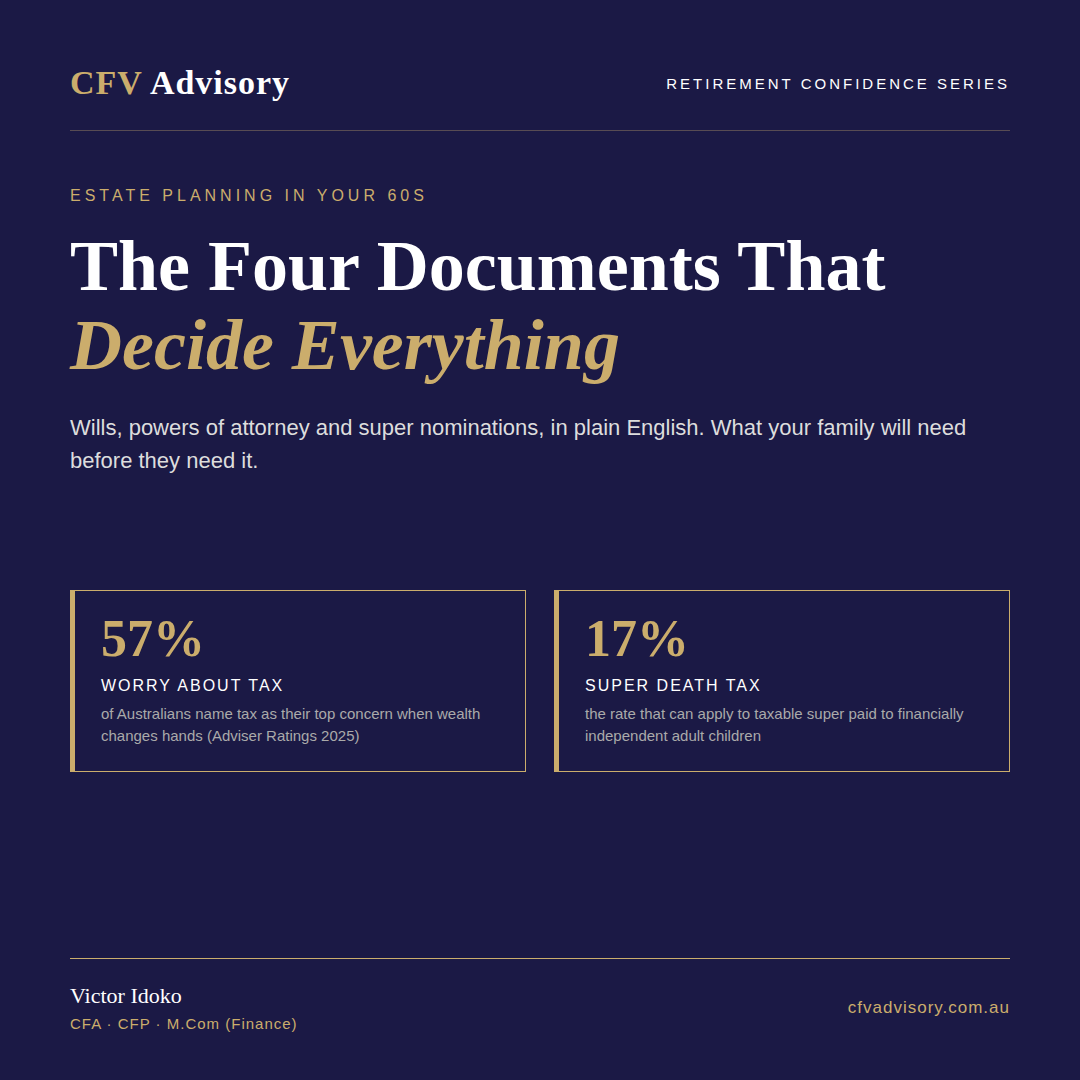
Estate planning in your 60s is less about death and more about decisions. If something happened to you tomorrow, would your family know what to do? In Adviser Ratings’ 2025 survey, 57% of Australians named tax as their biggest worry when wealth changes hands. Yet most couples we meet are missing at least two of the four documents that actually decide the outcome.
You have done the hard part. The home is almost paid off, super is solid, and the kids are grown. Estate planning in your 60s is simply the final piece of that work. It makes sure the right people can act, and the right people receive, without a dispute or a tax surprise.
Most couples put it off for understandable reasons. It feels morbid, the rules feel complicated, and nobody wants to be sold a product. However, the documents themselves are straightforward. In short, four of them do almost all of the work. This article walks through each one in plain English, and explains where the real traps sit.
“A will is not an estate plan. It is one of four documents, and for many couples it doesn’t even control the largest asset they own.”
Overview
The four documents at a glance
Your will controls less than you think
Start with the document everyone knows. A will directs the assets that form your estate. For most couples in their 60s, that means your share of the home and your cash accounts. It also covers shares or managed funds held in your name. Additionally, it names an executor, the person who carries the plan out.
However, several major assets sit outside your will. Superannuation is not an estate asset unless it is deliberately directed to your estate. Property held as joint tenants passes automatically to the surviving owner. Assets inside a family trust belong to the trust, not to you. As a result, a couple with $1.8 million in super and a jointly owned home is a common case. Their will may govern only a fraction of what they own.
The second trap is age. A will written when the children were teenagers rarely fits the family you have now. For example, an executor may have died, moved overseas, or simply become the wrong choice. Likewise, grandchildren, a child’s divorce, or a blended family can all change what “fair” looks like. Consequently, we suggest a review every three years, or after any major family event.
A testamentary trust for the grandchildren
For families with grandchildren, or a child in a fragile marriage, a testamentary trust inside the will is worth discussing. It can hold an inheritance in a protected structure and distribute income with flexibility. That said, the rules around trusts are moving, so it belongs on your review list rather than your to-do list.
Proposed — not yet law
On 12 May 2026 the Government announced a proposed 30% minimum tax on discretionary trust income. It is intended to apply from 1 July 2028. Existing structures would have a three-year rollover window, from 1 July 2027 to 30 June 2030. The announcement targets discretionary trusts; how the final legislation treats testamentary trusts is not yet settled. Nothing needs to change today, and no one should unwind a structure on an announcement. It simply means a trust decision made now should be reviewed once the legislation lands.
Finding: A will only speaks for estate assets. Check what actually sits inside your estate before you assume the will has it covered.
Enduring power of attorney: the document for while you are alive
Death is not the only event that stops you managing your affairs. A stroke, dementia, or a serious accident can do the same, often for years. An enduring power of attorney lets a person you trust manage your financial and legal affairs if you lose capacity. Crucially, it must be signed while you still have capacity. That is why it belongs in estate planning in your 60s, not your 80s.
Without one, your family cannot simply step in. Instead, they apply to a state tribunal, such as NCAT in New South Wales. The tribunal then appoints a financial manager. That process takes time, involves ongoing reporting, and the tribunal decides who acts. In other words, the choice leaves your hands at the moment it matters most.
Timing has become more practical, too. The new Aged Care Act commenced on 1 November 2025, along with its Support at Home program. Navigating assessments, contributions and provider agreements on your behalf is far simpler for a properly appointed attorney. Moreover, many super funds and banks will only deal with an attorney whose document meets their own requirements. Therefore, check that your document is registered where required and accepted by your fund.
Choosing the attorney deserves real thought. The eldest child is not automatically the right person. Instead, look for someone organised, good with money, and able to stand firm with siblings under pressure. Many couples appoint each other first, with an adult child as the substitute.
Finding: A power of attorney is a living document. It protects you, not your beneficiaries, and it must exist before it is needed.
Enduring guardian and advance care directive
A power of attorney covers money. It does not cover medical treatment or where you live. For those decisions, most states use a separate appointment. In New South Wales it is an enduring guardian. In Victoria it is a medical treatment decision maker, and Queensland folds it into the enduring power of attorney. The names differ, but the job is the same.
Alongside it sits an advance care directive. This records the treatment you would and would not want if you could no longer say so. Above all, it spares your children from guessing at the hardest moment of their lives. For instance, a directive can state your wishes on resuscitation, life support and palliative care in your own words.
Both documents are short and inexpensive. Even so, they are the two most commonly missing from the folders we review. In our experience, couples who complete them describe the same feeling afterwards: relief.
Finding: Money decisions and health decisions need separate authority. One document rarely covers both.
The super nomination: the biggest asset, the smallest form
For many couples in their 60s, super is the largest asset outside the home. Yet it is the one your will does not control. When a member dies, the fund’s trustee decides who receives the money. The only exception is a valid binding death benefit nomination. Without one, the trustee weighs up the claims of every potential dependant. That process can take months, and the result may surprise you.
A binding nomination fixes this. It tells the trustee, in writing, exactly who gets what. However, in many funds a binding nomination lapses after three years. As a result, a nomination signed in 2023 may already be worthless. Some funds now offer non-lapsing nominations, and an SMSF deed can be drafted for the same effect. Check yours this month, not next year.
If one of you is drawing an account-based pension, consider a reversionary nomination. Consequently, the pension continues to the surviving spouse rather than stopping and restarting. That keeps income flowing without a gap and avoids a rushed decision. The interaction with the transfer balance cap needs care, which is where advice earns its fee.
The 17% super death tax on adult children
Now to the number that worries 57% of Australians: tax. Super paid to a spouse is tax-free. In contrast, super paid to financially independent adult children is taxed on its taxable component at up to 17%. Any untaxed element is taxed at up to 32%. Consider this: a $1 million balance with an $800,000 taxable component leaves the children a bill of up to $136,000. Most balances built on employer and salary-sacrifice contributions are largely taxable.
There is a legitimate response. A withdrawal and re-contribution strategy converts taxable dollars into tax-free dollars, within the non-concessional caps. It must be done while you are alive and under 75. Moreover, it interacts with the transfer balance cap, Division 296 above $3 million, and the Age Pension assets test. In short, the mechanics are simple and the sequencing is not. That is exactly why it is planned, not improvised.
Finding: Your will does not decide who receives your super. A current binding nomination does, and the tax outcome depends on who that person is.
Why estate plans fail in real life
The documents above are the easy part. In our experience, estate planning in your 60s fails on execution and communication, not on legal drafting. Adviser Ratings found 30% of Australians worry about family conflict over wealth transfer. Meanwhile, 42% of advisers now provide family governance and wealth education as a direct response. The pattern is consistent, and so are the causes.
The five most common failures
1. Nobody knows where the documents are. The executor spends weeks searching, and the super nomination surfaces after the fund has already decided.
2. The nomination lapsed. A three-year binding nomination quietly expired, so the fund reverted to trustee discretion.
3. The executor was the wrong person. A sibling overseas, or one who avoids hard conversations, was named out of loyalty rather than suitability.
4. The plan was never explained. The children learned who received what from the will itself, and the one who felt short-changed contested it.
5. The plan was never updated. A grandchild, a separation, or the sale of the family home changed everything, but the documents stayed the same.
The fix for all five is the same. First, put every document in one place and tell the executor and attorney where it is. Second, write a short letter of wishes that explains your reasoning, especially where the split is not equal. Finally, hold one conversation with the adult children while you are healthy. Ultimately, that conversation prevents more disputes than any clause a lawyer can draft.
Finding: Most estate disputes begin with surprise, not greed. A plan the family already understands is far harder to contest.
Estate planning in your 60s: what a complete plan looks like
You do not need to fix all of this in a week. Start by finding the four documents. If two are missing, that is normal for couples in their 60s. It is also fixable within weeks. Put simply, the point of estate planning in your 60s is not to prepare for the worst. It is to make sure the life you have built lands where you intend it to.
At CFV, we model aged care and estate outcomes early, alongside the year-by-year retirement cash flow. That way, the estate plan and the retirement plan are the same plan. Victor covers estate planning, aged care and the Age Pension in this episode of the Elevate Your Wealth podcast. It is a good place to hear how these questions fit together. Also useful is our guide to how generational wealth is built and passed on with purpose.
Prefer to listen? Catch this episode on the Two Incomes, One Plan podcast.
About the author
Victor Idoko CFA · CFP · M.Com (Finance)
Victor is the founder of CFV Advisory, an Australian financial planning practice that helps couples move into retirement without an irreversible mistake. He is the author of 7 Basic Wealth Strategies and co-author, with Lionel O’Mally, of Bunnies & Monies, a children’s money series many clients now read with their grandchildren. He also hosts the Elevate Your Wealth podcast.
“You’ve done the hard part. Let’s make sure you get to enjoy it.”
If you would like to see how your will, powers of attorney and super nominations fit into a year-by-year retirement plan, we are happy to talk it through. No products. No pressure.
Don’t Wing It. Plan It.
General Advice Disclaimer: The information contained in this article is general in nature and does not take into account your personal objectives, financial situation, or needs. It is not intended to constitute financial or legal advice. Estate planning documents should be prepared by a qualified legal practitioner; CFV Advisory works alongside your solicitor and accountant. Before acting on any information in this article, you should consider whether it is appropriate for your circumstances and seek advice from a licensed financial adviser. Tax rates and superannuation rules are current at the time of writing and are subject to change. Victor Idoko is an Authorised Representative of a licensed Australian Financial Services Licensee.