
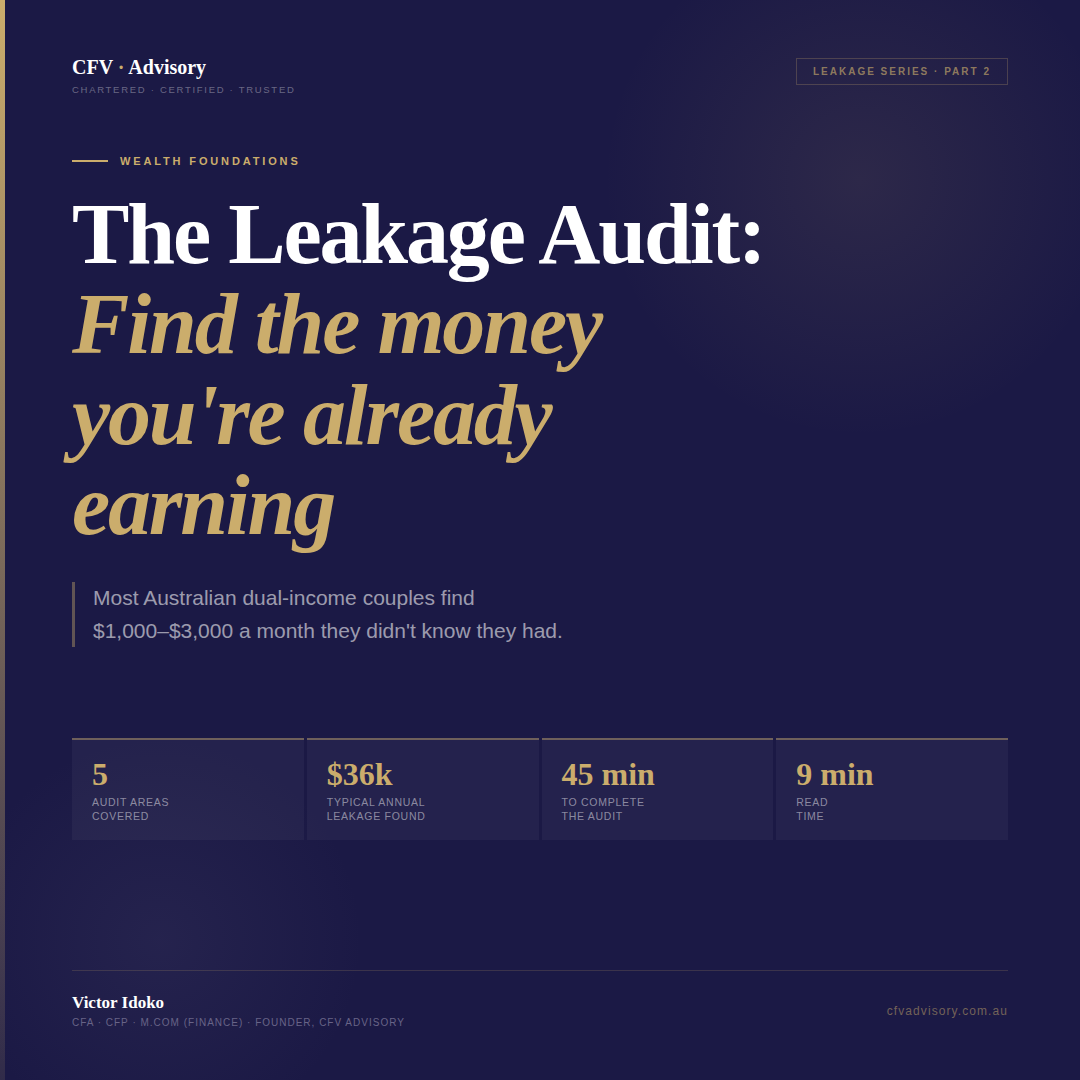
9 min read · Wealth Foundations · Leakage Series · Australian dual-income households
Most Australian dual-income couples who complete a financial leakage audit find $1,000–$3,000 a month they didn’t know they had. Here’s the exact five-step process to find yours.
You’re earning well. You’re not reckless with money. And yet the wealth you expected to be building by now feels somehow behind where it should be. If that resonates, you’re almost certainly leaking — and this financial leakage audit will help you find out exactly how much.
A financial leakage audit is not a budget review. It’s not about cutting lattes or living more frugally. It’s a structured examination of the recurring drains in your finances — losses that compound silently year after year, not because of poor decisions, but because no one has ever looked at everything together at once.
Work through the five areas below. For each one, get the actual number — not an estimate. The total will likely surprise you.
“The goal isn’t to find out where you’ve been wasteful. The goal is to find money you’re already earning that’s currently going to someone else.”
The Five-Area Audit — What You’ll Review
Audit Area One
Your Recurring Subscriptions & Services
Open your last two months of bank and credit card statements. Write down every recurring charge — anything that appears regularly, no matter how small. Don’t estimate. Go through every single line.
What to look for
-
Streaming services — count every one
Netflix, Stan, Disney+, Binge, Paramount+, Apple TV+, Spotify, YouTube Premium. Average couple spends $85–$140/month. How many do you actually use? -
Software subscriptions
Adobe, cloud storage, apps, tools. Check both partners’ accounts separately — overlaps are common. -
Gym, fitness, or wellness memberships
Log how many times you’ve used each in the last 90 days. -
Free trials that quietly converted to paid
These hide in statements as small, forgettable recurring charges. -
Delivery service memberships
DoorDash DashPass, Amazon, and similar — often held independently by both partners.
Typical finding: Australian dual-income couples pay for an average of 11–16 recurring digital subscriptions. After a thorough review, most eliminate 4–6 they’d genuinely forgotten about — saving $60–$180 per month immediately, with zero lifestyle impact.
Audit Area Two
Your Mortgage Rate & Debt Structure
Pull out your most recent mortgage statement and note your current interest rate — not what you think it is, what it actually is today. Then spend 15 minutes checking what comparable lenders are currently offering. This single step has produced the largest single savings for many of the couples we work with.
Questions to answer
-
What is your current variable or fixed rate, exactly?
Not an estimate — the actual rate on your most recent statement. -
When does your fixed rate period expire?
Many couples have rolled onto a high revert rate without realising it. -
Is your offset account properly linked and actively reducing interest?
An unlinked offset earns nothing. This is more common than you’d expect. -
Do you hold personal loans, car finance, or BNPL balances?
Calculate the combined monthly interest cost across all non-mortgage debt.
The rate gap: A 0.5% rate difference on a $900,000 mortgage costs $375 per month — $4,500 per year — going to your bank instead of your offset account. Many couples we review are sitting on a gap larger than this, because they refinanced years ago and haven’t looked since. Learn how to turn your mortgage into a wealth engine →
Audit Area Three
Your Insurance Policies — Combined
Gather every active insurance policy across both partners: those held personally, those held inside superannuation, and those provided through work. Lay them all together — ideally on one spreadsheet — and compare what each actually covers. The overlaps are rarely obvious until you do this.
Policies to list for both partners
-
Life insurance
Inside super AND any standalone policies — both partners separately. -
Total and Permanent Disability (TPD) cover
Amount, insurer, and whether held inside or outside super. -
Income protection
Check benefit periods, waiting periods, and whether it’s agreed value or indemnity. -
Private health insurance
Including what extras you’ve actually claimed in the past 12 months. -
General insurance
Car, contents, landlord if applicable — and when each was last reviewed for premium creep.
What we find most often: Duplicate life cover between super and standalone policies. It’s not uncommon to find $200–$400/month in combined premiums that could be eliminated or restructured — without reducing any meaningful protection.
Audit Area Four
Your Tax Position
You don’t need to be a tax expert to identify whether you’re likely paying more than required. The questions below are designed to surface the most common gaps we see in dual-income households. If you answer “I’m not sure” to any of them, that’s worth following up — particularly before June each year.
Key questions for both partners
-
Are you using salary sacrifice for super contributions above the employer guarantee?
One of the highest-leverage tools available to high-income earners — and the most consistently underused. -
Are your investment assets structured in the most tax-effective name?
Income-producing assets held in the higher-income earner’s name cost more tax than necessary. -
Do you hold investment properties — and are you claiming all eligible deductions?
Depreciation schedules, loan interest, and property management costs are frequently under-claimed. See what the ATO says you can claim → -
Have you reviewed your super fund’s fees and investment option in the last 3 years?
Fund fees compound against you the same way investment returns compound for you.
Common gap: A couple earning $180K and $95K who haven’t optimised super contributions could reduce their combined tax bill by $8,000–$14,000 per year — legally and immediately — with the right structure in place.
Audit Area Five
Lifestyle Cost Drift
Compare your current monthly spend with what it was two years ago. If you can’t do this precisely, compare your current savings rate with what you expected it to be when you were earning less. The gap between those numbers is lifestyle drift — the slow, invisible expansion of costs as income rises.
You’re not looking for a culprit. You’re looking for categories where spending has grown without a conscious decision to grow it — food delivery, after-work drinks that became regular, clothing spend that quietly doubled. These aren’t moral failures. They’re just leaks. And they can be redirected.
Where drift hides most often
-
Food delivery
Typically the fastest-growing category for dual-income households — often $400–$800/month without realising it. -
After-work and weekend dining
Socialising costs that embedded as income rose. Often the last place people look. -
Clothing and personal spend
Individual budgets that were never set, so never enforced. -
Children’s activities
Each one seemed reasonable. Together, they’re often $600–$1,200/month.
The question to ask: If your income dropped by $40,000 tomorrow, which of these costs would you cut immediately? Those are the ones you can redirect now — before anything forces your hand.
The range depends almost entirely on how long it’s been since you last looked at everything together. These are the actual ranges from completed financial leakage audits.
These aren’t aspirational figures. The higher end almost always involves a meaningful tax restructure that compounds into generational wealth or a mortgage rate correction — the things that tend to be overlooked because they feel complicated to address on your own.
The financial leakage audit itself takes 45–60 minutes to complete properly. The conversations it starts — about what to do with the money you find — tend to be some of the most useful financial conversations couples ever have.
About the Author
Victor Idoko
CFA · CFP · M.Com (Finance) · Founder, CFV Advisory
Victor Idoko is the founder of CFV Advisory and author of 7 Basic Wealth Strategies. With over a decade of experience in financial planning, Victor helps dual-income Australian families build clear, practical structures to grow, protect, and transfer wealth — without sacrificing lifestyle or relationships. His approach blends technical depth with the real-world side of wealth, so plans don’t just look good on paper. They work in life.
Follow the next articles in this series for the full framework — and when you’re ready to apply it to your own household, book a meeting with Victor here →
Want Us to Run This Financial Leakage Audit With You?
We offer a complimentary 30-minute review where we walk through your financial picture together and identify where your most significant leaks are likely to be — before you spend a cent.
Book Your Complimentary Review
No sales pressure. No obligation. Just a clear, honest look at your numbers.
General advice only. This article does not consider your personal objectives, financial situation, or needs. Victor Idoko is an Authorised Representative of CFV Advisory Pty Ltd. Please read our Financial Services Guide and consider seeking personal financial advice before making any financial decisions.